5/20/2026 — General Assembly leaders are threatening to bring a government shutdown to the Commonwealth, a scenario much more reminiscent of Capitol Hill than Capitol Square.
Despite unified Democrat control of state government, the General Assembly adjourned in March without sending a budget to Governor Spanberger’s desk. Virginia Scope’s Bradon Jarvis reported that
Senators are considering returning to Richmond as late as June 22nd to move the critical spending bill to Governor Spanberger’s desk.
While that’s already insanely close to the deadline, that is not a conversation they are having with the House, according to Appropriations Committee Chairman Luke Torian.
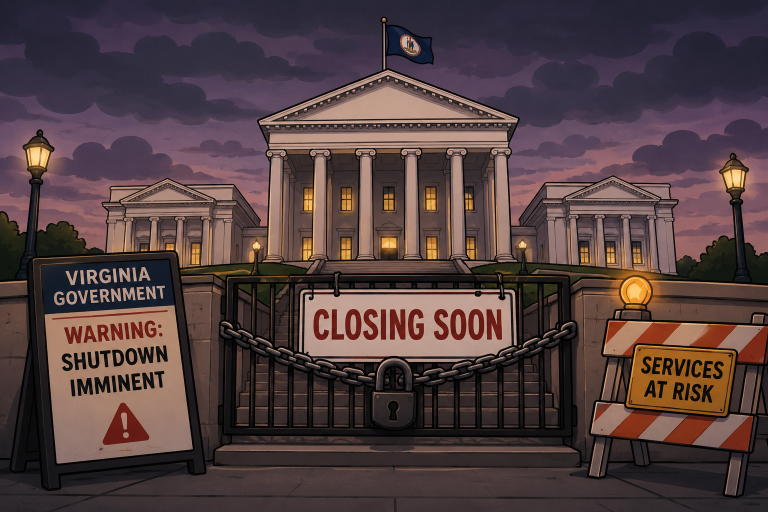
House Speaker Don Scott previously announced that the compromise to bridge the billion-dollar gap between House and Senate versions of the spending bill may not be ready until June. Spending authority for the entire state government expires on June 30. Without a new budget, Virginians will wake up to a “shutdown” state government on July 1st.
The Shutdown Threat is Real
While Virginia’s government has never “shut down” and the Code of Virginia lacks specific “shutdown” provisions afforded by federal law, state spending authority is almost wholly tied to the adoption of a biennial budget.
An opinion issued by then-Attorney General Bob McDonnell in 2006 made clear that state workers could not be paid starting July 1 (even for work done during the last pay period in June). The Governor’s emergency powers may compel employees critical to public safety, like the Virginia State Police, to work, but without pay. The Code was later updated to expressly prohibit state bodies from issuing “IOU” payments in absence of a state budget. In 2025, Delegate Jay Leftwich proposed a bill to address the McDonnell opinion, but it died in committee.
The Governor does have some enumerated powers which are related, but not relevant. Gubernatorial authority allows for impoundment of appropriated funds in case of a revenue shortfall, but not the reverse in the case of a lack of appropriations. Unspent general fund appropriations can be re-allocated among similar programs as part of the “carryforward” process, and independent agencies, institutions of higher education, the legislative and judicial branch all have carryforward rules favorable to continued spending.
In complete absence of a budget, Governor Spanberger may be tempted to declare a state of emergency. Under the Code, the Governor is “authorized to expend from all funds of the state treasury not constitutionally restricted, a sum sufficient. Allotments from such “sum sufficient” may be made by the Governor to any state agency or political subdivision of the Commonwealth to carry out disaster service missions and responsibilities.
Clearly, the failure of legislative leaders of her own party to send her a budget in time would be a “disaster” in a moral sense, but it’s hard to argue this fits within the definition of “emergency spending.”
Not Unprecedented, But Weird
During the mid-2000s, under Republican-control of the House and Senate and Democratic control of the governor’s mansion, biennial budgets were adopted in June on more than one occasion. House and Senate Republicans often found themselves on opposing sides of each other, as well as the Governor. Under Governor McAuliffe, the perennial post-Obamacare fight on Medicaid expansion also led to shutdown brinksmanship games.
The current shutdown crisis is objectively different. First, the state government is fully in control of Democrats, and partisan affiliation is stronger and is more closely tied to policy alignment with most liberal Republicans and most conservative Democrats having long since been pushed out of office. Second, previous budget fights that went into “overtime” led to a tremendous amount of anxious conversation about the risk of a shutdown among local governments, institution of higher education, the news media and other General Assembly watchers. The anxiety certainly exists, but the conversation has been quiet so far.
Finally, this budget fight is over little more than politics and personalities. In previous years, no matter whose side you were on, it was hard to argue that Medicaid expansion, transportation, and the ongoing structural budget balance concerns were not real issues that required the urgent attention of the General Assembly. The shutdown showdowns were not good, but they were at least understandable.
In this case, we started with a structurally balanced budget introduced by outgoing Governor Youngkin. Then, House and Senate Democrats decided to go on a spending spree which they hoped to fund through increased revenue from new gaming, retail marijuana, or a tax increase on one of Virginia’s largest private industries. When they failed to come to agreement on those new sources of revenue, including the Governor’s realized and reported vetoes, they are left with a budget hole completely made of their own new spending.
The “11th Hour” Problem
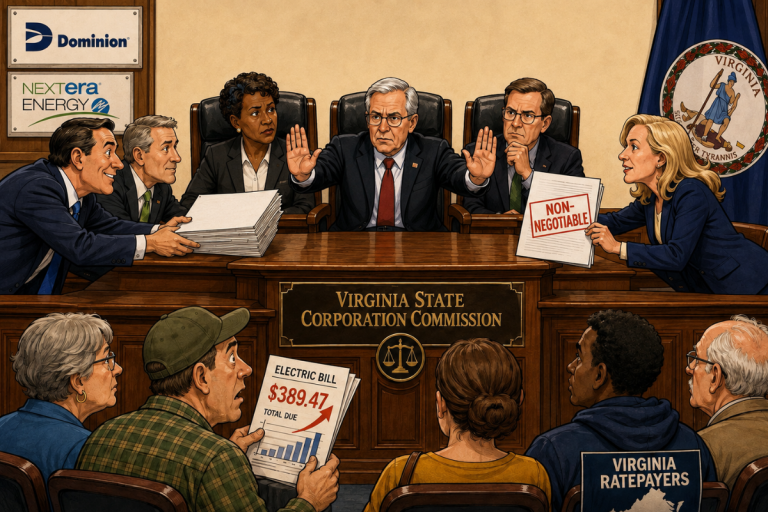
The budgets adopted in June, as the figurative “11th hour,” usually include tax increases and other unpopular items. This is clearly a possibility. Despite chest thumping from the Governor and Speaker about tax increases introduced but not adopted, the Governor told WRIC’s Tyler Englander that increases on personal services like haircuts and gym memberships, and digital services like Netflix and Dropbox, were “a worthy conversation.”
Late yesterday, the Governor publicly asked her Secretary of Finance to reevaluate the revenue forecast; a move often deployed during session to make sure the spending in the adopted budget is as close to the revenue being collected as possible. The “post-session” reforecast has few possible motivations. It might help Senator Louise Lucas out of a political bind, showing higher revenues and allowing Lucas to back down on her billion-dollar tax increase plan. The post-session reforecast might also point to declining revenues, opening the door to the “worthy conversation” of additional tax increases.
In the dead of night that the “11th hour” brings, House and Senate Democrats may also force the Governor’s hand, again, on the legislative priorities they have been tussling about since March. Governor Spanberger has made several high-profile vetoes against priorities of key legislators. Skill game legalization, the Tysons casino, banning ICE from making arrests in courthouses, collective bargaining, the prescription drug affordability board, trial-lawyer benefitting class action lawsuits, and retail marijuana are all out. But the General Assembly can put them back in as additional enactments tucked in the back of the budget.
If a budget bill is dropped on her desk on June 22nd, she will be limited in her ability to offer amendments without becoming the “trigger” of the government shutdown. When the budget is amended, it does not go into effect but goes back to the General Assembly for consideration.
She will have one other option. While not nearly as nimble, the Governor can “item veto” whole budget items and the spending they authorize. The power has been successfully used, most recently by Governor Youngkin, to veto out additional enactments tucked into the back of the budget.
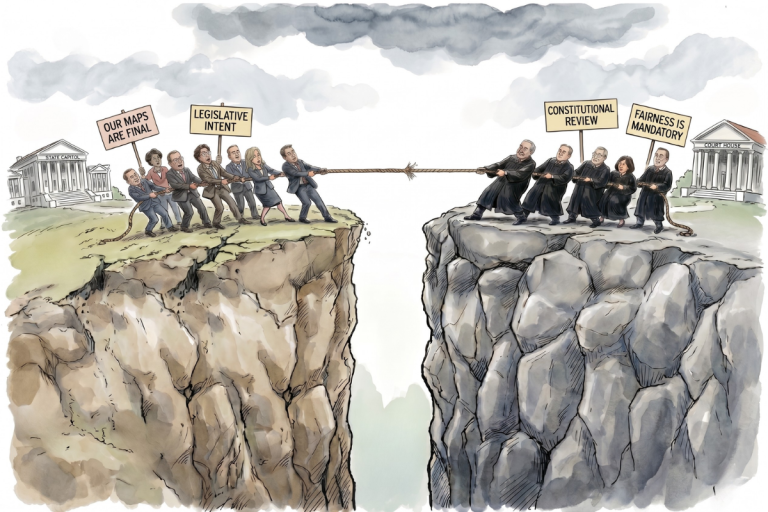
If the legislature presses the issue, this sets up the once-sleepy Supreme Court of Virginia for yet another set of monumental rulings. While the “Capitol Square Shutdown Showdown” is certainly fun to watch, it’s not good for Virginia.
Ali Ahmad is a Senior Visiting Fellow at the Jefferson Forum and served as the Deputy Chief of Staff for Governor Glenn Youngkin. Ali can be reached at ali@jeffersonforum.org