For several years, opponents of data center growth in Virginia have advanced a simple political narrative: data centers consume enormous amounts of electricity, therefore they “must” be driving up electric bills for ordinary Virginians.
It is an emotionally intuitive and persuasive argument. It is also increasingly unsupported by the evidence.
A new analysis from the Institute for Energy Research directly examined electricity prices, electricity demand growth, and data center concentration across all 50 states. The findings should fundamentally reshape the debate in Virginia, home to the world’s largest concentration of data centers.
The report found no statistically significant correlation between the number of data centers in a state and either current electricity prices or faster price increases over time. In fact, the ten states with the most data centers, including Virginia, Texas, California, Illinois, and Ohio all had electricity prices almost identical to the national average.
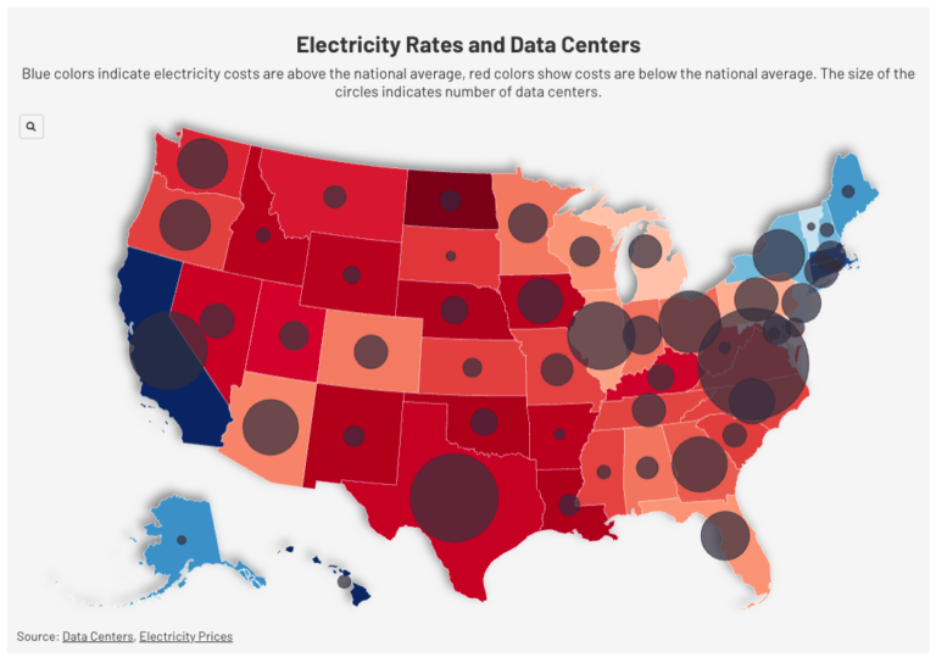
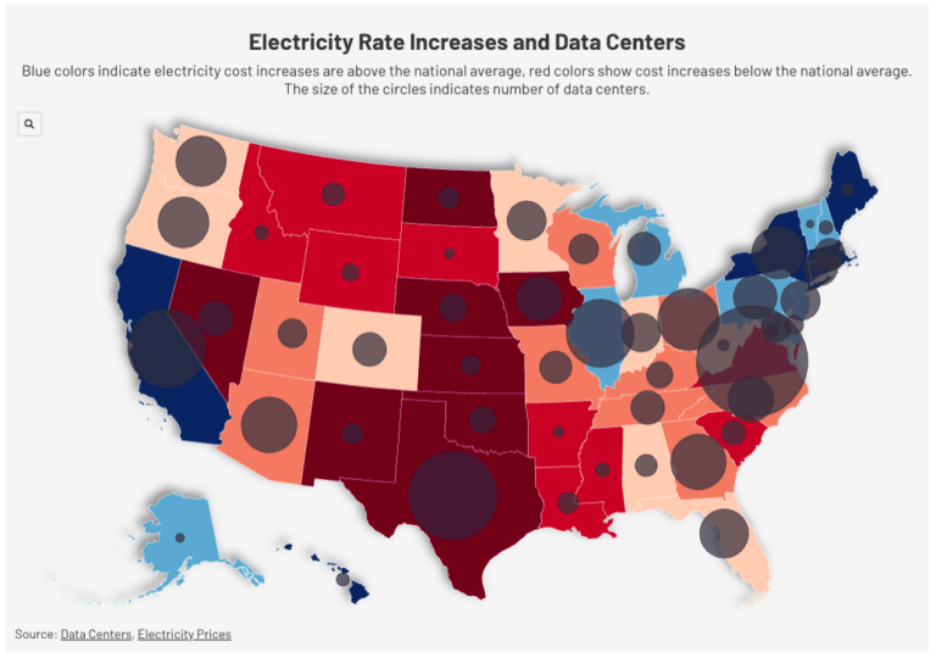
That matters because Virginia has become ground zero in the national political fight over artificial intelligence, cloud computing, and energy demand. Politicians, including many in Richmond, increasingly portray Northern Virginia’s “Data Center Alley” as a threat to household affordability. Some activists have even called for moratoriums on future construction, or removing permits for already approved projects. Yet the empirical evidence increasingly suggests the opposite: high-growth electricity demand can actually help stabilize prices by spreading fixed infrastructure costs across a larger customer base.
How is this possible?
Electric utilities are unlike most markets. The overwhelming share of electric costs are fixed costs: transmission lines, substations, generation assets, grid maintenance, reliability reserves, and regulatory compliance. When more electricity is sold across that infrastructure, those fixed costs can be distributed across more kilowatt-hours. That dynamic can actually ease upward pressure on rates rather than intensify it.
The IER report found exactly that pattern nationwide. States with stronger electricity demand growth often experienced smaller rate increases than states with stagnant or declining electricity demand.
That conclusion should not surprise anyone familiar with Virginia’s broader economic story.
Data centers have become one of Virginia’s greatest economic development successes. Northern Virginia is not merely a regional hub; it is arguably the digital capital of the modern economy. A massive share of the world’s internet traffic passes through Virginia servers every day. A 2024 Joint Legislative Audit Review Commission study found the industry supports 74,000 jobs, generates $5.5 billion in wages and contributes $9 billion annually to the state’s economy. According to Barbara Comstock in the Richmond Times-Dispatch, in the past two years, data centers invested more than $80 billion in the Commonwealth and generated billions in state and local tax revenue – including $1 billion annually in local tax revenue in Loudoun County alone.
Critics correctly note that data centers consume tremendous amounts of electricity. That is undeniably true. Lawrence Berkeley National Laboratory estimates U.S. data center electricity consumption grew from 76 terawatt-hours in 2018 to roughly 176 terawatt-hours by 2023, a 131% increase in just five years.
But acknowledging rising demand is not the same as proving causation for higher rates as opponents allege.
Indeed, many of the states suffering the worst electricity affordability crises are states with aggressive renewable mandates, constrained generation construction, overreliance on intermittent energy sources, or heavy regulatory burdens. The IER analysis points strongly toward state energy policy, not data center concentration, as the larger driver of electricity price divergence between states.
That distinction is crucial for Virginia policymakers.
If Virginia chooses to undermine its data center industry by removing the tax incentives that are largely credited with making Virginia the data center capital of the world (as is being pushed by the Virginia Senate and Sen. L. Louise Lucas), or through punitive environmental regulations (as being proposed by the House of Delegates), or with arbitrary county zoning restrictions, the Commonwealth risks damaging one of its strongest economic sectors while doing little to reduce electric bills. Worse, Virginia could unintentionally push future investment to competitor states while still facing the same underlying infrastructure and regulatory cost pressures.
None of this means legitimate concerns should be ignored. The IER study is backward looking, and future data center growth on a grid that has little to no plans to increase baseload, dispatchable power generation will face a different economic reality. As Jefferson Forum’s Steve Haner has warned there is a serious demand-supply disconnect in Virginia caused by the Virginia Clean Economy Act’s carbon restricting mandates. Virginia needs more power generation, and it needs it now. Grid reliability matters. Even supporters of data center growth should acknowledge that forecasting errors or poor utility regulation could eventually impose costs on consumers if policymakers are careless.
But conservatives should resist the temptation to adopt simplistic anti-growth populism merely because it polls well.
Virginia became prosperous because it welcomed investment, embraced innovation, and had a good foundation of relatively affordable and reliable energy compared with many blue-state competitors. The answer to future electricity demand is not a moratorium on data centers or new taxes to slow their growth. It is more generation, more transmission, faster permitting, and policies that encourage abundant and reliable (dispatchable) energy production.
In many ways, the debate over data centers is becoming a proxy war over whether Virginia still believes in growth itself. Governor Spanberger would do well to signal to data centers and other high energy consuming businesses during the budget negotiations that Virginia chooses growth and remains open to business.
Derrick Max is Vice President of Policy at the Jefferson Forum and may be reached at dmax@jeffersonforum.org