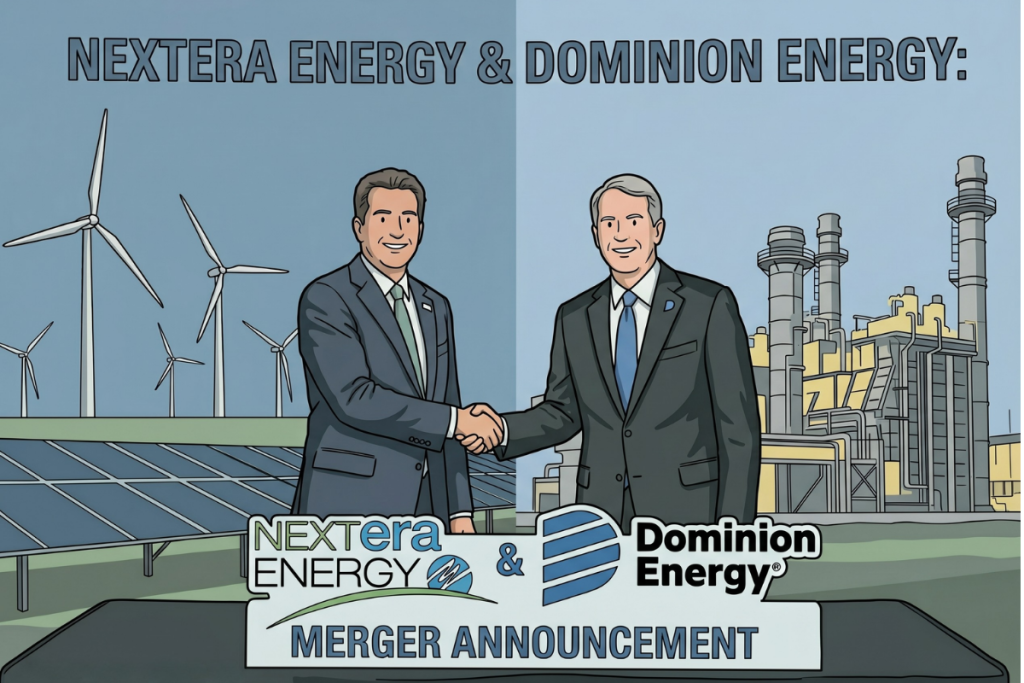
5/19/2026 — Assuming Dominion Energy Virginia is indeed absorbed into an expanded NextEra Energy, the more things change the more they may stay the same. The average consumer might see no real difference in their service or their cost.
This step was probably inevitable. Credit (or blame) the massive electricity demand growth facing Virginia, especially in the Dominion territory and the member cooperatives inside the same footprint, coupled with the constraints on energy solutions imposed by the Virginia Clean Economy Act.
Whether you read the initial news release from the companies, the slide set they released or the transcript of the discussion Monday with investors, what excited the leaders of both companies is the tens of billions of dollars in capital (half a trillion dollars was mentioned in one interview) that will need to be invested in the next two decades. Dominion on its own couldn’t do that.
The 2026 General Assembly added a battery mandate to the Virginia Clean Economy Act that requires Dominion to acquire almost 21,000 megawatts of battery storage (enough to run its system all by itself some days). Much of it must be long duration batteries, with total capacity exceeding 120,000 megawatt hours. Mandating that level of capital spending may have been intended to attract a buyer for Dominion.
Always remember that regulated monopoly electricity providers such as Dominion and NextEra’s Florida Power and Light (FPL) earn a rate of return on their invested equity, on the power plants, transmission lines, distribution lines and now battery installations they own. The capital comes from investors, and the projects are paid off with profit margins over decades by their ratepayers.
The acquisition of the full Dominion Energy portfolio by NextEra still faces a long and contentious regulatory review, by federal officials and then state regulators in Virginia, North Carolina and South Carolina. Different questions arise when the proposal is examined from different points of view.
Is this a good deal for the company’s shareholders? That was a major focus of the announcement, and a strong case was made that it would be, especially for Dominion’s shareholders. The shareholders must vote to approve it, of course.
Is this a good deal for the customers of the regulated utilities in Virginia, North Carolina, South Carolina, and Florida? That they will remain fully regulated is a strong point. The promised two years of bill credits for Dominion customers has gotten way too much media attention, because that is – to borrow a phrase – a spoonful of sugar to make the medicine go down. As customers, we might want that money spent elsewhere (heresy, I know.)
But most important, especially to Jefferson Forum and others interested in the long-term stability, reliability and cost of energy, will this larger company be better able to meet the coming demand wave hitting Virginia and some other states, largely due to the data centers? That should be the primary focus of the regulatory review. What best serves the economy?
With the announcement and the initial reactions behind us, a few key points have emerged.
The combined entity, which will be the largest retail electricity provider in the United States, claims its size will give it improved credit rates and thus lower borrowing costs. That should also give it more market leverage with the suppliers of the expensive generators and grid components it will need. Both claims are credible, if unproven.
The combined entity will also be a political player far more formidable than either company was on its own. Both companies have proven they are happy to leverage that power within state capitals and in Washington. NextEra’s aggressive history was highlighted in one of the few negative reactions to Monday’s news, coming from Clean Virginia.
And the environmentally purist Clean Virginia might have also been reacting to a third clear point. Both companies are happily spending money on solar, wind and batteries but also see the continuing need for natural gas in the decades to come. The phrase “all of the above” kept being mentioned Monday. Gas is as large a part of FPL’s baseload generation as it is Dominion’s. A more political muscular utility may have an easier time slipping off the leash of the Virginia Clean Economy Act.
That is one of the risks investors in the combined entity would have to look at. Virginia’s political leadership remains hostile to natural gas. Dominion’s approved gas plant in Chesterfield County still faces a court challenge, and its announced plans for an even larger and more crucial gas-fired plant in Cumberland County will create a firestorm of opposition.
NextEra has made comforting promises to Dominion’s employees, but they are short term. Eventually, the corporate employee base is bound to migrate away from Virginia and toward the headquarters in Florida, with its far more friendly tax and regulatory environment. The Democrats in our General Assembly are proving quite willing to raise the cost of labor here (Paid Family and Medical Leave, Mandatory Paid Sick Leave, etc.) and it will eventually bite.
Virginia’s State Corporation Commission will explore all these questions, with a particular emphasis on whether this will be good, bad, or neutral for customers. As noted Monday, the 2026 General Assembly did nothing to address the growing gap between electricity supply and demand in Virginia, or to restrain customer cost increases. The ultimate question for the SCC will be, will this acquisition improve either situation?
Steve Haner is the Senior Fellow for Energy and the Environment at the Jefferson Forum and may be reached at Steve@thomasjeffersoninst.org