4/30/2026 — Between Friday March 6th and Tuesday April 21st, a narrow majority of Virginia voters went to the polls (or to their mailboxes) and voted in favor of the disenfranchisement of rural Virginia, as part of a national effort to make New York Representative Hakeem Jefferies the Speaker of the House next year.
Of course, without shamefully deceptive ballot language and tens of millions of dollars of outside money, the vote easily could have gone the other way. And while it’s over, it has yet to be certified, and when, or even if, that happens is an open question.
Legal
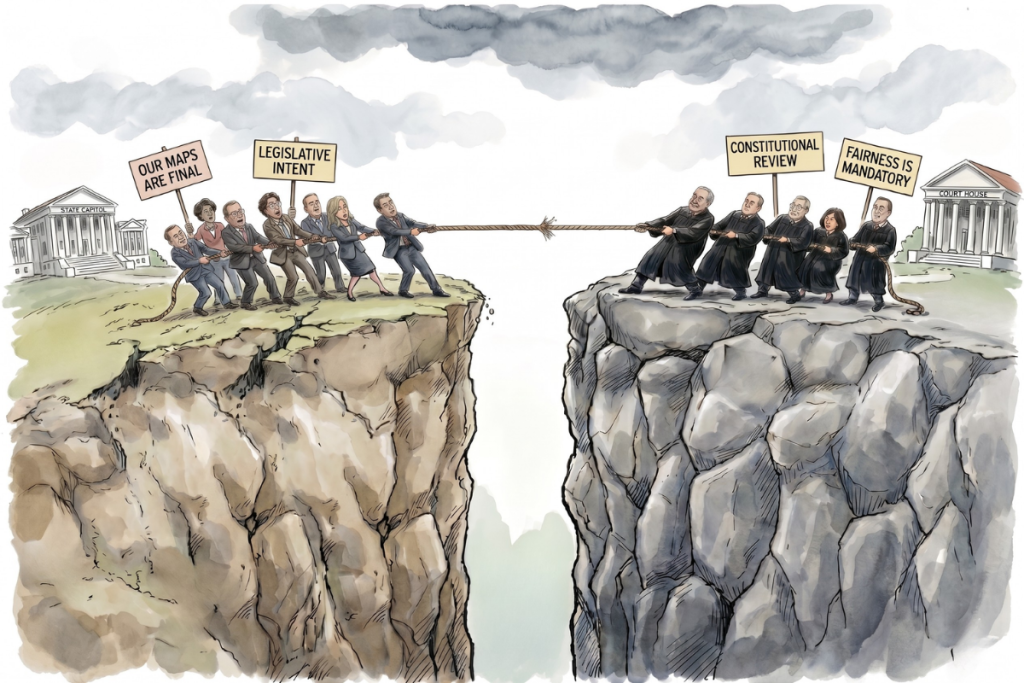
Monday April 27 saw the long-awaited oral arguments at the Supreme Court of Virginia (SCOVA) in Scott v. McDougle (named after the Democrat Speaker of the House and the Republican Senate Leader).
I corresponded with Zachary Werrell, an attorney and author who is an expert in both Virginia law and politics. Werrell noted that both sides received tough questions and cautioned against reading too deeply into courtroom dynamics or trying to parse the intensity of the justice’s questions to each side.
He did note, however, that both of the justices who did ask questions were “locked onto” two key issues:
“First, may the General Assembly fail to adjourn a special session, and then recall that special session and conduct legitimate legislative activities in that recalled special session after a subsequent regular session has been held?”
“Second, may the General Assembly pass the proposed constitutional amendment for the first time within mere days of the constitutionally required ‘intervening election’ and fulfil the procedural and substantive requirements for a constitutional amendment?”
Werrell noted, “the questions themselves seemed to indicate [the justices] had grave concerns over the propriety of this amendment.” He believes the amendment should be overturned.
“The entire purpose of having two passages of a proposed constitutional amendment separated by an election of the General Assembly is to give voters a chance to provide indirect feedback on a proposed amendment by having that inform their votes on members of the legislature. The way this amendment was first proposed represents an intentional, flagrant, and brazen effort to completely undermine the reason for having an amendment passed twice by the legislature, separated by an election.”
Werrell is less inclined to believe the Court will rule on the other key line of questioning, whether the General Assembly can continue its “special sessions” through regular sessions and then return to them, taking legislative action even on items unrelated to the initial call.
While the court may not weigh in, this is a critical public policy question. Virginia’s constitution may be silent, but it certainly does not contemplate a year-round legislature.
Injunction Upheld
A separate ruling from the Tazewell Circuit Court (RNC v. Koski) has enjoined the State Board of Elections against certifying the results of the April 21, 2026, elections, the next key step in implementing the rigged maps. On Tuesday, SCOVA denied a request from Attorney General Jay Jones to stay that injunction.
In a post on X, former Attorney General Ken Cuccinelli, who cautions against reading “tea leaves” nevertheless notes: “this is as positive a ‘tea leaf’ as one might imagine!” Cuccinelli also noted in a press conference after the oral arguments that a decision may take until the middle of May.
If the election remains uncertified, the move to the rigged maps cannot begin. Voters must be moved from the current (fair) districts to the new (rigged) districts. Early voting in primaries was slated to start June 18 and for candidates across the Commonwealth, especially if the certification drifts too far into May, that timetable will become untenable.
For ongoing coverage and much deeper analysis, I commend readers to follow AG Cuccinelli and Zachary Werrell, as well as Delegate Wren Williams and former Delegate Tim Anderson.
What’s Next? A Political Backlash
Governor Spanberger has dismissed concerns that rural voters will be disenfranchised by placing a majority of urban and suburban voters in their rural districts noting she represented a rural district in Congress but could “not keep her basil plants alive.” Democrat leader and Richmond Senator Lamont Bagby has assured rural Virginians that his affection for The Waltons, Opie Taylor, and the Duke Boys means he understands their lives.
All kidding aside, without legal relief, we face the harsh reality that rural Virginians have absolutely been disenfranchised by the vote. Regardless of the impact on the makeup of Virginia’s delegation, the real effect of the manifestly absurd 7th district “lobster” and other tortured district lines is that the collective political voice of rural and exurban areas is overwhelmed by the collective political voice of the slices of the more densely populated areas.
The supposed temporary nature of this affront is no comfort, and it is clear to any observer of past redistricting efforts that the rigged maps, if in place for the next several election cycles, will weigh significantly on the next redistricting effort. The process put in place by the voters in 2020 was designed to be incumbent-blind and was also designed to not favor either political party.
Just as the rigged maps favor one political party, the backlash to the amendment will certainly favor one political party. If the rhetoric of the Republican’s new chairman, Jeff Ryer, is any indication the Republican Party of Virginia was energized by this redistricting fight.
If this referendum is thrown out, that renewed energy is likely to have an even greater impact as they will have a more favorable map and a rallying cry of “Democrat overreach.” Democrats will have to explain to rural voters why they voted to disenfranchise them. Democrats will have to explain to voters in the bipartisan district maps why they were planning to move to a different, more friendly district. Finally, Democrats will have to explain to donors how so much of their money could be wasted on a constitutionally questionable process.
As Ryer noted, “The actions of Governor Spanberger and the Democrat majorities in the General Assembly have united Republicans across Virginia. Their efforts to turn us into “East California” have created unity among Republicans and revulsion among the majority of Virginians. We are ready for the challenges facing us.”
The Virginia Public Access Project notes that 11 localities that supported Governor Spanberger in November 2025 voted “no” this year. UVA political analyst J. Miles Coleman notes that of the 13 seats flipped by Democrats in 2025, 9 voted “no.”
The Jefferson Forum has actively opposed this redistricting effort, not on partisan grounds, but because of the process, wording, and unfairness of the approved map. Seeing the party that pushed this referendum punished may be the only way to ensure our bipartisan maps return and remain in place regardless of who holds the gavels in the General Assembly.
Ali Ahmad is a Senior Visiting Fellow at the Jefferson Forum and served as the Deputy Chief of Staff for Governor Glenn Youngkin and may be reached at ali@jeffersonforum.org