Today’s referendum isn’t complicated.
It’s not really about “fairness.” It’s not really “temporary.” And it’s not really about Virginia.
It’s about power.
The Great Reversal
For years, Democrats, from Barack Obama on down, warned that gerrymandering was a threat to democracy itself. In fact, the left nationally, and in Virginia, have been more vocal in opposition to gerrymandering than the right. They weren’t wrong.
Virginia voters agreed, and responded by ending politician-drawn maps, they thought, for good.
Now, under the leadership of Abigail Spanberger, who herself was a leading voice opposing gerrymandering, the argument has flipped: gerrymandering is acceptable – even necessary, so long as it helps “their side” in a national fight against a President they hate.
That’s not a principle. That’s an excuse.
If partisan map-drawing is wrong in Texas or North Carolina, it’s wrong in Virginia. If it undermines trust there, it undermines trust here.
“Temporary” That Lasts for Years
Governor Spanberger keeps calling this change temporary. But in politics, time is measured in election cycles, not press statements. This proposal would govern congressional elections for the rest of the decade, six years and three election cycles, at least. That is not temporary. It’s not a stopgap. It is a political eternity and sets a precedent that will be hard, if not impossible, to unwind.
A National Power Play.
Let’s be honest about what’s happening. This referendum is part of a national spat between two national parties hellbent on redrawing maps to keep or take power.
Some states like Texas and California have voted to join this spat, others like Indiana and Maryland have voted to stay out.
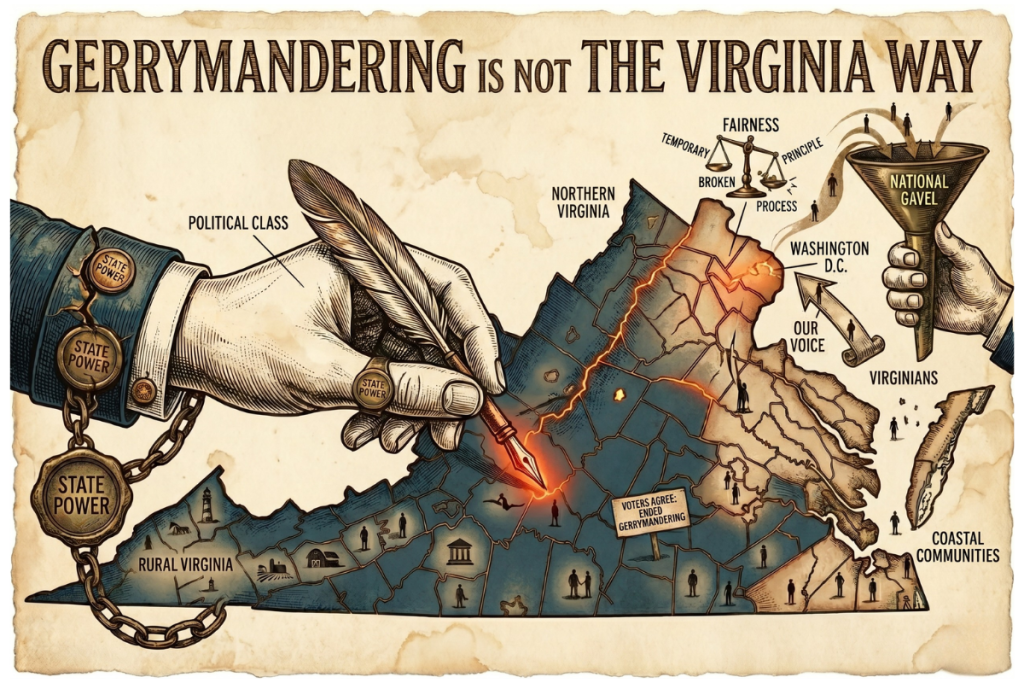
By most projections, the net gain in seats from this mid-decade redistricting favors Democrats, but only barely. Add in a 10-1 redrawing in Virginia, and Democrats net gain likely puts them over the top – and their odds of capturing the gavel in Washington become nearly certain.
Virginians are being asked to abandon the neutral process for which they voted, not because it failed, but because it prevents the party currently in control from manipulating the system to benefit their team nationally.
That’s a dangerous precedent.
Who Really Loses in Virginia
Every redistricting fight has winners and losers. But here, the geographic implications are hard to ignore.
Northern Virginia alone could effectively control five congressional seats, consolidating influence in a single region already dominant in statewide politics. Meanwhile, rural communities would be carved up, stretched across districts, and increasingly drowned out. A state as diverse as Virginia should be wary of any plan that concentrates influence in fewer regions and fewer voices.
A Rushed and Confusing Process
Then there’s how this referendum got to the ballot in the middle of April.
The process has been rushed. Legal questions have hovered. And the ballot language is wrapped in vague appeals to “fairness” when even proponents admit that it is not fair within the borders of the Commonwealth, but “necessary” to counter actions taken in other states. That’s not how major constitutional decisions should be made. That is not how ballot questions should be written. That is not the Virginia Way.
The Choice Before Virginia
Strip away the messaging, and the choice is straightforward:
Virginia can keep its best in the nation non-partisan redistricting process, or it can jump headfirst back into a system of partisan gerrymandering run by politicians seeking power.
Do we continue to lead with our best in the nation system or do we join this senseless gerrymandering silliness?
Virginia has spent years working to get redistricting right. Walking that back now because the political math has changed would be a mistake that could last for decades.
Derrick Max is VP of Policy at the Jefferson Forum and may be reached at dmax@jeffersonforum.org