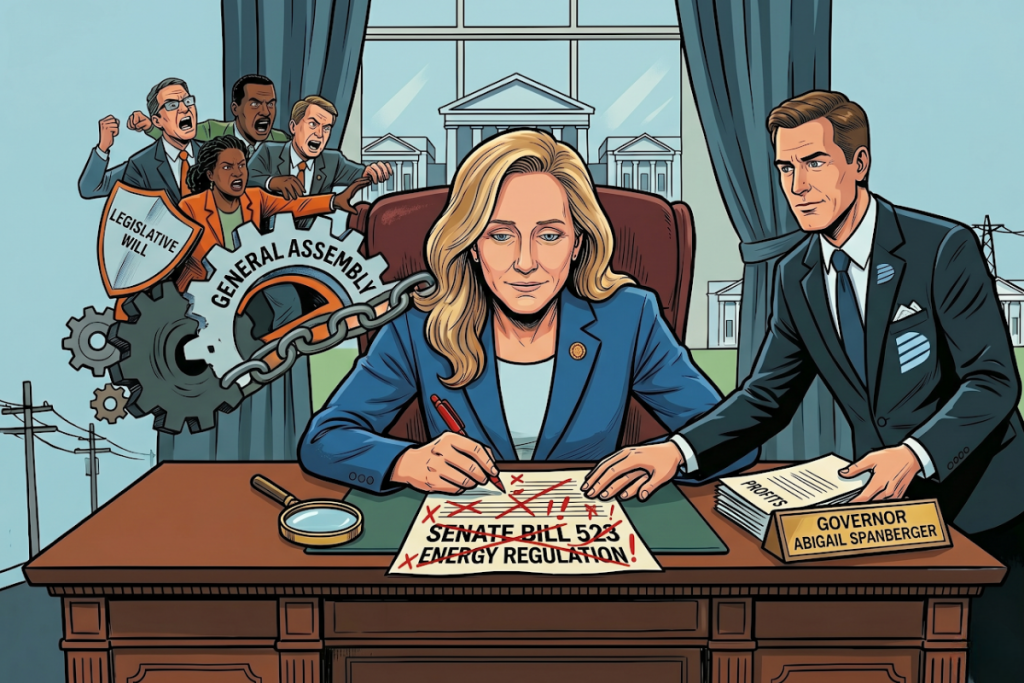
Governor Abigail Spanberger (D) has proposed that the General Assembly return to the misguided practice of dictating by law a utility profit margin, overturning a bipartisan reform approved just three years ago. It is no different than her effort to end the bipartisan reforms against political gerrymandering and again put politicians in charge of that.
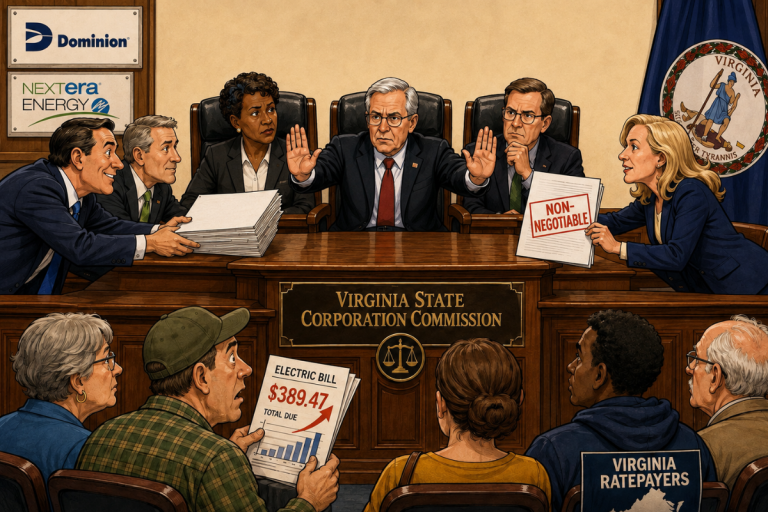
A profit cap on Dominion Energy Virginia is one of several aggressive proposed amendments she has offered to the complex bill dealing with a host of energy regulations. She, and the Assembly’s leading Democrats and Dominion Energy face a three-way collision at the Reconvened Session this Wednesday.
In focus is the most written about energy proposal of the session, which started as an innocuous proposal on utility spending for energy efficiency upgrades. By the end of the session it had taken on additional baggage, supposedly destined to “lower power bills” by shifting additional costs onto Virginia’s new favorite scapegoat, the data center industry.
It was one of the nine bills Jefferson Forum identified last month as likely to increase future ratepayer electric costs. Looking at the fate of the other eight, seven of them Spanberger signed and one is the subject of a technical amendment. The likely higher costs are still coming. Nothing that passed this year is going to add major new power generation within Virginia (balcony solar panels are window dressing).
By the final revisions to Senate Bill 253 and its House counterpart, that promise of lower bills was threadbare, but advocates could still claim the bill might help residential ratepayers down the road. Spanberger’s proposed amendment guts what remains, simply directing the State Corporation Commission (SCC) to do what it is already supposed to do – prevent different classes of customers from subsidizing the other classes.
In another part of the bill, Spanberger would greatly increase the SCC’s authority to say no to Dominion’s expensive and profitable program to retroactively bury residential power lines, something which was due to expire in a couple of years but which the Assembly authorized to live – and continue to cost all Dominion customer money – an additional five years. Her amendment includes language that would end the SCC’s obligation to automatically consider projects reasonable and prudent.
And in a third blow to the utility, a proposed addition to the bill unrelated to anything the Assembly voted on would reverse the SCC’s recent decision on Dominion’s allowed profit margin. Where her first two proposals recognized the SCC’s authority, this final one limits the SCC. It slams the door on the signature energy achievement of Republican Governor Glenn Youngkin’s administration, a 2023 bill returning to the SCC full control over profit margin decisions.
Lowering the company’s allowed return on equity from 9.8 to 9.3 percent, and ordering refunds for customers if the utility exceeds that target, will be touted as pro-consumer. But a return by the Assembly to micromanaging the SCC is a horrible outcome, at any price. As with gerrymandering, Spanberger is breaking again something we all thought had been fixed.
The Dominion program to bury residential lines has long been a target for criticism, and it would be nice to think Spanberger was responding to this author’s years of complaints. But on this issue and the others she was more likely listening to her huge donor and Dominion’s nemesis Clean Virginia. It testified against this part of the omnibus legislation.
Clean Virginia had also petitioned the SCC for a much lower Dominion profit margin. Here is Clean Virginia mirroring Dominion’s usual tactic and running to a politician it financed to overrule the regulatory court. The merry-go-round has turned another full circle, and nothing has really changed. You have permission to be discouraged.
One key point on this bill Spanberger is carving up is that nothing about it is required. No damage is done if she ends up vetoing it because her amendments are rejected. A full veto would be a great outcome for consumers. This puts more pressure on the legislators to approve her suggestions to avoid losing everything.
But most of the bad energy ideas they forwarded to her were signed without issue. She signed the bills allowing means tested rates for water and sewer utilities, potentially charging the majority of customers extra money to subsidize rates for low-income customers. That idea is bound to spread to electricity and natural gas.
Identical bills to revamp the utility integrated resource planning process and more fully incorporate the goal of rapidly ending the use of hydrocarbon fuels were signed without amendment. While no bill passed to prevent the utilities from gaining approval for future natural gas generation, mandating consideration of an imaginary “social cost of carbon” creates an added barrier.
Spanberger signed a bill to change the existing Commission on Electric Utility Regulation (CEUR) into the Energy Commission of Virginia. At the beginning of the session, Senate Bill 515 called for a major expansion of that legislative panel’s scope into all forms of energy, even home, transportation and industrial uses. The commission itself, led by Senator Scott Surovell, D-Fairfax, had asked to oversee the natural gas industry and absorb the role of another commission overseeing the coal industry.
The ambitions were broad, but it all came to nothing, perhaps because of growing tensions between majority party factions. Spanberger could have offered amendments to strengthen the commission’s hand again but did not. The bill as introduced encroached on the prerogatives of the SCC but could also be seen as competing with the executive branch. The signed bill accomplishes only the name change, which ends the practice of pronouncing the commission’s acronym as “sewer.”.
Dashing the legislative lust to oversee all things energy in our economy is a positive outcome. But the desire runs deep and will surface again. Now it seems well entrenched in the Governor’s Office.
Steve Haner is the Senior Fellow for Energy and the Environment at the Jefferson Forum and may be reached at Steve@thomasjeffersoninst.org