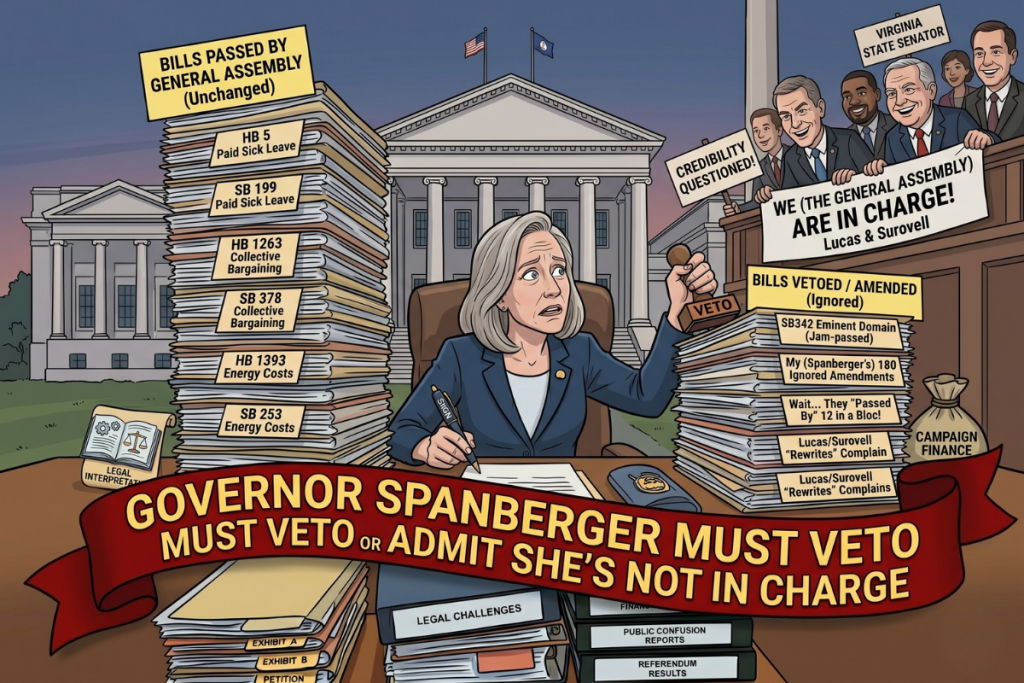
This session, the General Assembly sent over 1,000 bills to Governor Spanberger for her signature. She signed 852 into law, vetoed 8 and proposed amendments to 180. Even though some of her amendments were little more than window dressing (see article on Paid Family and Medical Leave) and a few were substantive, the General Assembly during its reconvened session on Wednesday ignored her amendments on over two dozen bills.
The Senate even took 12 of the amended bills, lumped them into a bloc, and voted 21 to 18 to “pass them by for the day.” In other words, they didn’t even give the Governor the courtesy of a debate on many of her ideas. This dismissive tactic may or may not be unprecedented, but it was clearly a power move that tells the Governor that the General Assembly believes it is in charge.
On one bill, SB342, dealing with eminent domain, the Governor sought to do a reenactment clause as her amendment. In that one case, a motion was made that the bill become law regardless of the objections of the governor. That takes the same supermajority vote as overriding a veto, and legislators from both parties passed it in both the House and Senate. That motion to jam a bill past the governor has happened successfully before but is very unusual when the majority is the same party as the governor.
In short, Governor Abigail Spanberger identified real problems in major legislation — and the General Assembly ignored her almost entirely, and in some cases, rudely so.
The reaction from the General Assembly, including her own party, was not limited to legislative backhands. It was vocal, and in the open press. Senate Majority Leader. Scott Surovell (D) complained that the governor’s modest and important changes were “basically entire rewrites” and added: “We have a whole lot of new policy positions that were not communicated to us… It’s hard to legislate when the governor doesn’t let us know what her position is.”
Senate Finance Committee Chair Louise Lucas challenged the governor more bluntly: “The problem she (Spanberger) has to correct is… credibility.” That is not routine legislative friction. That is a legislature signaling it believes it is in charge.
Now comes the moment that will define Abigail Spanberger’s governorship for the next three and a half years. Will she act like the chief executive of Virginia and veto those returned bills, or will she now sign bills she has already described as flawed?
Let’s take a closer look at several of these bills that are back in the Governor’s hands:
Paid Sick Leave (HB 5 / SB 199)
Governor Spanberger pointed out several real problems in the paid sick leave mandate — especially how broadly it applied and how unclear compliance would be for employers. This is something we have pointed out would be in effect a 3.3 percent employment tax for businesses in the Commonwealth. No small sum.
Gov. Spanberger rightly attempted to clarify definitions of covered workers, to provide employer compliance guardrails, and to narrow provisions likely to trigger disputes and litigation (language sought by the trial lawyers). The General Assembly rejected her amendments outright.
So now the Governor faces a simple choice: Sign a mandate she believed needed fixing or veto it.
Collective Bargaining (HB 1263 / SB 378)
On collective bargaining, the Governor went further still. She attempted to delay implementation until after she would be out of office, to require budget approval safeguards, and to preserve local control over bargaining. In other words, she tried to prevent exactly what we warned about: a rapid expansion of union power without fiscal guardrails.
Again, the legislature said no. By “passing it by” the majority rejected t her protections and sent the bill back unchanged. If she signs it now, she is knowingly approving a policy she tried to slow down and constrain mostly because it would undo her efforts to increase affordability in the Commonwealth.
Energy and Utility Costs (HB 1393 / SB 253)
This is where the stakes are highest and where the Governor’s instincts were often right. Only three of Governor Spanberger’s eleven proposed amendments to an omnibus electricity regulation bill were accepted, with the other eight summarily rejected. The rejected changes were substantial and prudent enough that she would be justified in now vetoing SB253 and its House counterpart with all their provisions. As they passed initially and are now amended, they do nothing positive for ratepayers.
Spanberger quite correctly sought to give the State Corporation Commission more leeway to reject Dominion Energy Virginia’s ongoing program to bury existing residential distribution lines. It is an expensive project that has long been questioned on cost grounds by the SCC’s staff, and those complaints were joined this year by the advocacy group Clean Virginia.
But to the detriment of the ratepayers who do not get the new buried lines, but simply will pay for them, the Assembly maintained this profit center for Dominion though 2033. It also rejected Spanberger’s effort to put a cap on the utility’s allowed rate of return on equity. That amendment had the same noble goal but was a misguided attempt to undercut the SCC’s role.
One portion of Senate Bill 253 and its House companion was initially promoted as making the large data centers pick up a far greater share of certain energy costs, lowering bills for residential users. One of the Spanberger amendments that was adopted has ended that fiction for good. But Virginia is still better off if the bill just goes away entirely.
This is the clearest way to explain the actions in the energy sector: The Governor identified some structural problems with the most complex bill she was sent and made mostly reasonable amendments. The legislature rejected those changes and is now asking her to sign bills that she knows will increase costs for ratepayers or fail to address underlying issues she had sought to fix.
The Test of Control
What makes this moment so striking is that Governor Spanberger’s amendments on all these bills were not ideological objections. They were governing objections – does the bill impose unintended costs, is it workable, and can it be improved, or does it shift risks to taxpayers? That is the Governor’s job to ask, and she did her job. But now she must finish it.
Here’s the reality. If she signs the bills sent back to her, she sends a message: the legislature governs and the Governor just makes suggestions. If she vetoes them, she sends a different message: The Governor of Virginia still exercises judgment — and authority.
A veto is not a failure. It is the constitutional check that ensures bad policy does not become law simply because it has the votes, even if those votes are mostly from your same party. The General Assembly has made its move. Now Governor Spanberger must make hers. Because right now, legislative leaders like Senators. Lucas and Surovell are acting like they are in control.
And unless she vetoes these returned bills on paid sick leave, collective bargaining, and energy in particular, they will be right.
Derrick Max is Vice President for Policy of the Jefferson Forum and may be reached at dmax@jeffersonforum.org. Steve Haner is Senior Fellow for Energy and the Environment at the Jefferson Forum and may be reached at Steve@ThomasJeffersonInst.org.