4/27/2026 — One of the most striking themes from last Wednesday’s reconvened session was the widespread rejection of Governor Spanberger‘s recommendations. Legislative Information Services shows that of 180 bills amended, the legislature adopted 137, placing those bills straight into law without returning them to her desk.
For the first time in decades, the General Assembly also preemptively overrode the Governor’s potential veto on a bill she amended. That bill now passes into law without the opportunity for additional action by the Governor. Essentially cutting the Governor out of the process. The rest of the bills are back on her desk for a final 30-days of bill review.
Many of the bills where the Governor’s recommendations were rejected were, without a doubt, some of the most sweeping changes to Virginia law adopted by the legislature this session.
Senate Majority Leader Scott Surovell (D-Fairfax) said he was “disappointed” that these changes were proposed “at the 11th hour instead of during the legislative process.”
The Governor IS Part of the Legislative Process
This language is a deliberate obfuscation of the legislative process outlined by the Constitution of Virginia. A 60- or 45-day session is followed by a 30-day Bill Review by the governor, then a Reconvened Session and then a subsequent 30-day review on any bill that has been returned to his or her desk.
During the first Bill Review, the Governor retains extensive powers to make amendments (formally called Governor’s Recommendations) to bills. This is a critical part of the process precisely because our part-time legislature rushes to pass 1,000 bills in a very short window. Several dozen of the bills each year will be complex and require significant negotiations over changes between chambers and with outside interest groups until the very end of the session.
The language of the final bills and conference reports sent to the Governor may not have been fully read, and certainly not digested, by every member of both chambers.
More importantly, the final language of bills has not been seen by all agencies responsible for implementation; all advocates, all stakeholders affected, and all members of the public who are following bills of interest.
Our Constitution affords the Chief Executive a window to continue to review the practical implementation of the legislation and gives him or her the responsibility to propose amendments to those bills.
What’s Next?
The General Assembly leadership clearly chose not to follow Jefferson’s rule to “take things by the smooth handle” because of their desire to rein in the new Administration. Now she has an opportunity to respond.
My colleagues Derrick Max and Steve Haner argue convincingly that she must veto to maintain the necessary checks-and-balances between the branches. Her post-reconvene press release said “I will continue to work with the patrons of the bills that are coming back to my desk to make sure that when these bills become law, we get it right. In the coming weeks, my priority will be to help facilitate getting a budget to my desk.”
Under normal circumstances and a regular order, this strongly implies that the bills returned would be vetoed. The promise to work on them “before they become law” would mean the reintroduction of consensus bills at the beginning of next session in 2027.
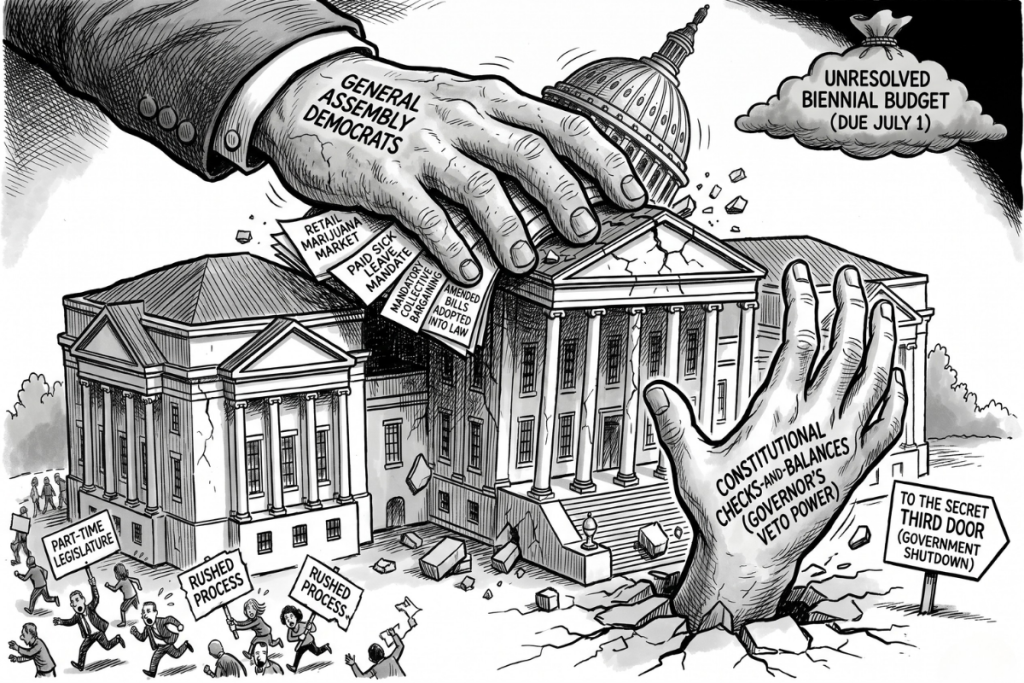
But there’s a “secret third door” this year.
The Democrat-led General Assembly failed to deliver a new biennial budget to the Governor’s desk last week. Speaker Scott made clear that the budget may not be delivered until June (after the Governor’s deadline to act on remaining bills).
A June budget would be delivered after the May 22nd deadline for the Governor to act on the bills returned to her. Budgets always contain additional enactments that change the code; essentially bills tucked in at the back.
The General Assembly and the Governor could make amendments after they are signed but before they go into effect. Or, if they continue to square off… we could see some of the same bills (as well as some of the vetoed ones) back on her desk with days to go before the Virginia government would face a July 1st shut down.
A Bad Direction for the Commonwealth – Regardless of Party
During both the 2024 and 2025 General Assembly sessions, a flippant and dismissive response to the Executive Branch role in the process could be chalked up to partisan posturing or a real difference on policy outcomes. But last week’s actions felt different.
General Assembly Democrats were truly incensed by the Governor offering any recommendations on substantive bills as dramatic as a state regulated retail and recreational marijuana market, a massive paid sick leave mandate that will dramatically shake up compensation packages and staffing decisions for businesses large and small, and a mandatory collective bargaining bill which will overrules local autonomy and undermines workers’ voting rights.
To be clear, from a policy standpoint, I believe these three bills should have been vetoed out of the gate because they will make Virginia a less affordable place for families, less healthy place to raise children, and harder place to create or find a job.
As someone who has worked across multiple sessions, however, I’m surprised that the Democrat leadership, bill patrons, and outside groups chose to force the newly elected Governor’s hand. The General Assembly returns every year, and incremental changes to the law as new policies are enacted is a key step in the proverbial sausage making.
This legislative brinksmanship on display last week is bad when it is interparty. It is worse when it’s intraparty. And in an even numbered year, when the Commonwealth must adopt a new biennial budget, it is potentially disastrous.
Ali Ahmad is a Senior Visiting Fellow at the Jefferson Forum and served as the Deputy Chief of Staff for Governor Glenn Youngkin. Ali may be reached at Ali@jeffersonforum.org