
Key Takeaways:
- Abdul El-Sayed’s Michigan primary victory demonstrates that candidates backed by Bernie Sanders and Alexandria Ocasio-Cortez can win major statewide nominations while openly promoting higher taxes, Medicare for All and greater government control of the economy.
- America’s progressive-run cities reveal the consequences of government-centered policies where high taxes, extensive regulation and expansive public programs lead to greater struggles with unaffordable housing, failing schools, public disorder and limited economic mobility for lower-income residents.
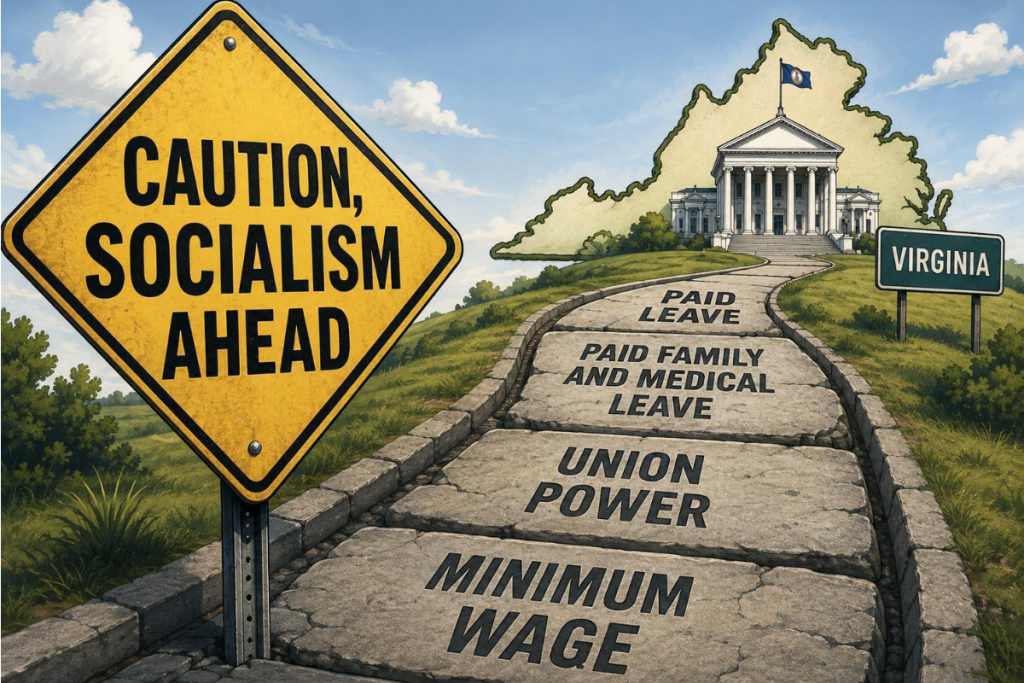
- Virginia is advancing socialist-aligned policies without using the socialist label. Higher minimum wages, mandated paid sick leave, government-directed family leave and expanded public-sector collective bargaining closely resemble the Democratic Socialists of America’s agenda and represent an incremental expansion of government power.
Key Quote: “Socialism rarely arrives in America with politicians promising to confiscate every factory. It advances incrementally — one wage mandate, one payroll tax, one compulsory benefit, one housing control and one government-union contract at a time.”
8/5/2026 — Abdul El-Sayed’s narrow victory in Michigan’s Democratic primary for the United States Senate marks another important advance for the socialist wing of American politics.
Backed by Sen. Bernie Sanders and Rep. Alexandria Ocasio-Cortez, El-Sayed defeated the Democratic establishment while campaigning for Medicare for All, higher taxes on corporations and wealthy Americans, and a larger government role in determining economic outcomes.
His victory matters beyond Michigan because socialism is no longer confined to a handful of congressional districts in New York and California. Candidates aligned with the broader democratic-socialist movement are demonstrating that they can compete successfully and openly for major-party nominations in politically consequential states.
Before Americans embrace their promises, however, they should examine the places where the underlying socialist philosophy has been tested most extensively.
One need not look overseas.
While the United States has not abolished private property or nationalized its industries, it has conducted decades-long experiments with something approaching democratic socialism in many of its largest cities.
New York, Chicago, Detroit, Los Angeles and San Francisco, to name a few, still contain private businesses and enormous concentrations of wealth. Yet their governments have also embraced combinations of high taxation, extensive regulation, rent controls, expansive benefits, powerful public-sector unions and one-party political rule.
These cities offer a practical test of the belief that greater government control will produce greater equality, affordability and opportunity. Have they delivered safe neighborhoods, affordable housing, effective schools and economic mobility – especially for their lowest income residents? No.
In education, many large urban school systems continue to produce deeply troubling reading and mathematics results despite enormous spending. Wealthier families escape by moving, paying private-school tuition or purchasing tutoring. Lower-income families remain trapped in institutions controlled by politicians and unions that frequently resist giving them comparable choices.
Housing tells a similar story. Los Angeles and San Francisco have imposed layer upon layer of zoning, permitting and regulatory restrictions that make housing difficult and expensive to build. New York combines a severe housing shortage with extensive rent regulation. Government restricts supply, prices rise, and progressive officials then cite the resulting unaffordability as justification for still more subsidies and controls. This is how you end up with a Zohran Mamdani in the Mayor’s office.
While crime has recently declined in some cities, concentrated violence, public disorder, open-air drug activity and retail theft remain serious concerns in most urban neighborhoods. The people most exposed to those failures are rarely the affluent progressives designing these poverty creating economic and criminal-justice policies. They are lower-income residents who cannot purchase private security or move away.
The broader failure is one of accountability.
When urban schools fail, the political establishment demands more money. When housing becomes more unaffordable, it demands greater control. When businesses leave, it seeks additional taxes from those that remain. When government programs disappoint, officials insist that the real problem is that government has not yet been given enough power.
Every intervention becomes the justification for another.
Virginians may believe these urban experiments — and El-Sayed’s victory — have little to do with the Commonwealth. They should look more carefully.
Virginia may not have elected its own Alexandria Ocasio-Cortez. Few holding offices in Richmond openly campaign as democratic socialists.
Those that ran on the socialist moniker in Virginia last night lost resoundingly. Yet many policies associated with the socialist left are clearly advancing in Richmond, without the socialist label.
Virginia’s higher minimum wage, compulsory paid sick leave, government-directed paid family and medical leave program and repeated attempts to expand public-sector collective bargaining closely track major elements of the Democratic Socialists of America’s economic agenda.
The ideological overlap is unmistakable.
DSA advocates paid family leave for every worker, a government-established living wage, stronger unions, expanded public benefits and a much larger public role in providing economic security. Virginia is already moving in that direction. The question is whether accumulating mandates, taxes, entitlements and bureaucracies ultimately produce the prosperity and independence their advocates promise.
America’s cities provide ample reason for doubt and alarm.
Socialism rarely arrives in America with politicians promising to confiscate every factory. It advances incrementally — one wage mandate, one payroll tax, one compulsory benefit, one housing control and one government-union contract at a time.
El-Sayed’s victory finally puts an honest label to the creeping socialist philosophy taking root in many parts of America — which should ultimately help sharpen today’s political debates.
Virginia’s progressive may not carry the socialist label, but political ideas do not need to arrive carrying socialist membership cards. They arrive through legislation. The bills passed in the last General Assembly are ample evidence that the ideas of the Democratic Socialists of America have taken root right here in the Commonwealth.
Before Virginia travels farther down that socialist road, voters should examine both the candidates now advancing socialism nationally, the cities where government-centered progressivism has governed the longest, and the legislative agendas of the “progressives” seeking to represent them.
Derrick Max is Vice President of Policy at the Jefferson Forum and may be reached at dmax@jeffersonforum.org