Key Takeaways:
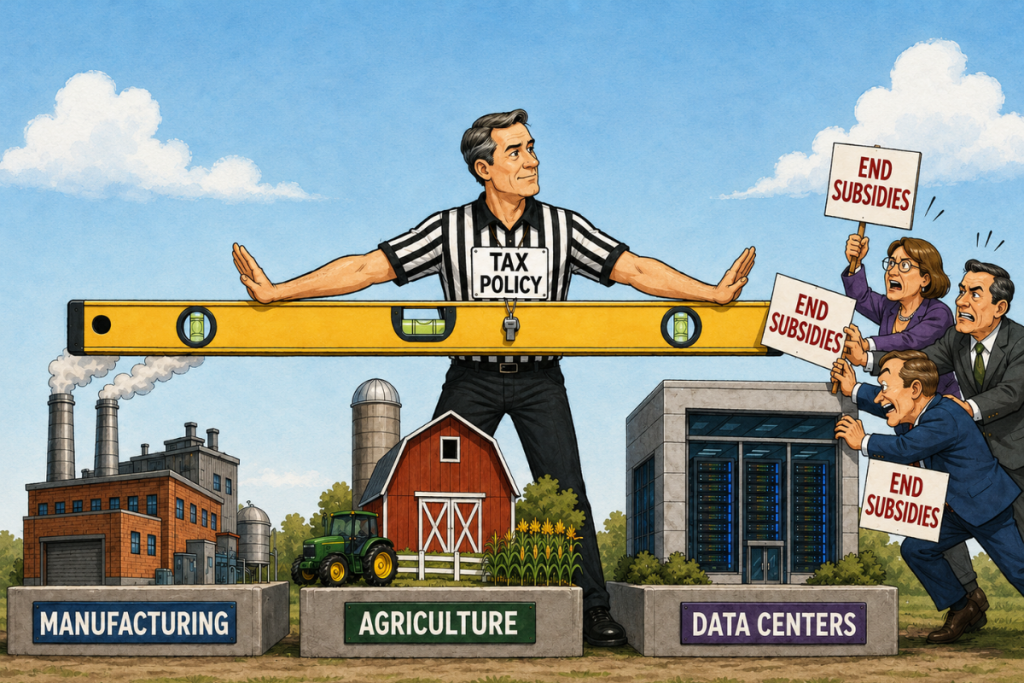
- Data center equipment tax exemptions are not unusual and generally mirror longstanding sales-tax treatment for machinery and equipment used by manufacturers, farmers, and other industries.
- Virginia’s data centers may face stricter treatment than other sectors because their exemptions depend on meeting investment and job-creation requirements, while many industries receive comparable exemptions automatically.
- Sound tax policy should be neutral toward investment: Eliminating the exemption would impose unusually high taxes on data centers and distort economic decisions rather than create a fairer tax system.
Key Quote: “The appropriate tax treatment of data centers is the same as that of other industries.”
8/4/2026 — When Jared Walczak writes something down, you should read it. Whether you agree with his analysis or whether it serves your politics, you’ll be a little bit smarter.
Everyone on any side of the ongoing data center debate in Virginia and across the nation should read his latest paper for the National Taxpayers Union (NTU): Sound Policies, Not Subsidies: Data Center Equipment Tax Exemptions.
Walczak is among the nation’s leading experts on state tax policy, having spent the past decade working in various roles at the Tax Foundation, the leading source for sober, nonpartisan analysis of state, federal and local tax policy. His analysis of Virginia, where he began his career as a policy analyst and legislative staffer, is always acute.
In his new paper, the first of three for NTU, he injects some important context into the debate over sales and use tax exemptions for data center equipment – a dispute that pushed the Commonwealth to the brink of its first-ever state government shutdown.
In short, “[d]ata centers are not getting special treatment but rather slightly worse treatment, as they must meet eligibility standards to claim an exemption that should be available by right and is available for equipment used in manufacturing, agriculture, and other sectors.”
Walczak notes, as summarized in NTU’s post that, “[s]ales tax exemptions for purchases of raw materials and equipment are a longstanding feature of most state tax codes.” Forty-one states exempt machinery and manufacturing equipment from sales tax in contrast to 33 states offering sales tax exemptions for data center equipment. Even more importantly, the manufacturing exemptions are largely “by-right” whereas data center equipment purchases are “conditional or discretionary.”
The paper argues that eliminating the exemption for data center equipment purchases would impose exorbitantly high taxes on data centers. It concludes that “the appropriate tax treatment of data centers is the same as that of other industries,” because tax policy should be neutral toward investment.
Read the entire study here or Jared’s summary on his public Substack, The Salt Road.
There are legitimate debates over the role public money, whether through tax policy or direct expenditures, should play in any industry’s development. Conservatives, liberals, and progressives find themselves on different sides of the debate all the time.
As a conservative, I believe policy should always be developed from core principles, but we should be humble enough to acknowledge that friends and allies will disagree on what those are or how to interpret them. The space to have that conversation is the scarcest commodity in politics.
Public policy is something made within a polygon defined by overlapping political realities. I don’t expect Jared’s paper to turn the current debate on its head in Virginia or in any state. But I do think everyone should read it.
Ali Ahmad is a Senior Visiting Fellow at the Jefferson Forum and served as the Deputy Chief of Staff for Governor Glenn Youngkin.