Your costs will rise, not decline
Key Takeaways:
- Expert testimony raises serious doubts about the Dominion–NextEra merger. The SCC staff, Attorney General’s experts, and PJM market monitor have raised concerns that the merger could harm Virginia ratepayers, increase costs, or concentrate too much market power. These findings deserve greater weight than political endorsements or opposition.
- Governor Spanberger is using the merger to advance her renewable energy agenda. Rather than focusing on affordability and reliability, the Governor is demanding accelerated compliance with the Virginia Clean Economy Act, new renewable energy subsidies, and policies that could further increase electricity costs.
- The SCC must put ratepayers ahead of politics. The central question is whether the merger will deliver reliable electricity at fair and reasonable rates. Approval should not depend on political concessions, employment guarantees, or commitments to energy policies that could undermine Virginia’s long-term economic competitiveness.
Key Quote:
“Yet Governor Spanberger is willing for the combination to go forward if her conditions are met. Her position now is ‘Yes, if’ and her ‘if’ is a price that will wreck Virginia’s energy future.”
10/20/2026 — Which has done more harm to the proposed sale of Dominion Energy? The fresh testimony from important stakeholders who are opposed to its acquisition by NextEra Energy, or the effort by Governor Abigail Spanberger (D) to use this opportunity to enforce her renewable energy mandates?
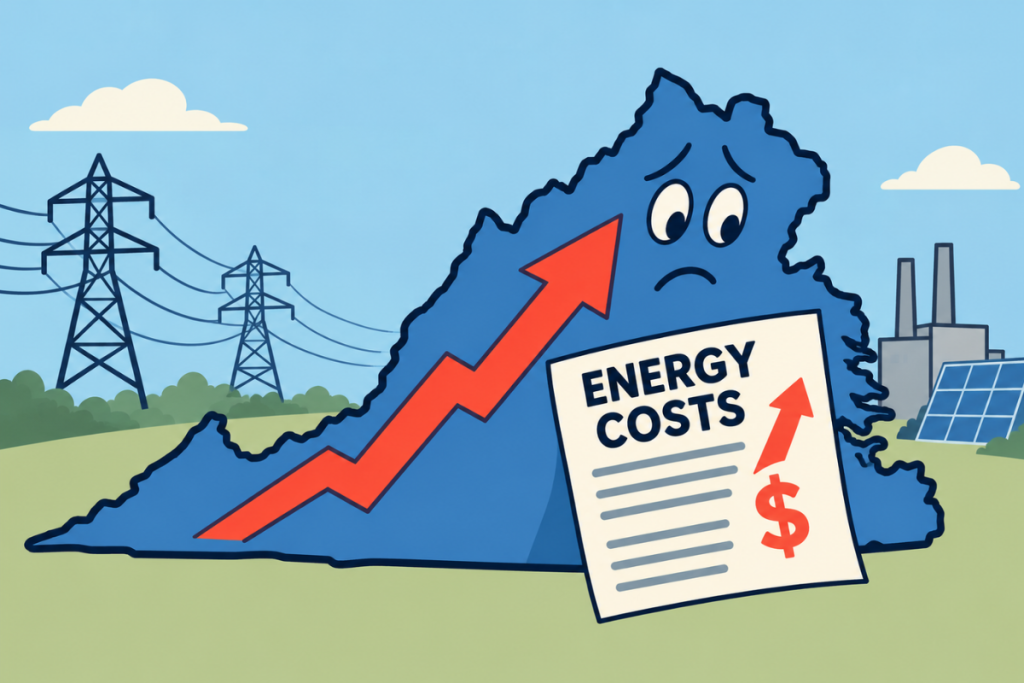
It is the second that should concern Virginians more. Virginia will undoubtedly be worse off if she succeeds in imposing her vision. Your costs will unquestionably rise in the long run.
Dominion Energy is the parent of Dominion Energy Virginia, Virginia’s dominant electric utility and a company under stress from massive energy demand growth. Should NextEra Energy acquire it, the expanded $67 billion company would be the largest U.S. electricity provider and the third largest energy conglomerate. Both firms say the combined financial strength is needed to build the generation and power lines Virginia needs.
The legal standard to be used by the State Corporation Commission (SCC) in approving or denying it is simple: will Dominion under the new ownership continue to provide reliable service at the fairest possible price? Or will the combination of the two companies harm ratepayers in the long run?
While many have rushed to judgement in favor or against this deal, in most cases their positions were more ideological or political than based on evidence. It was prudent to wait for the record at the State Corporation Commission, where testimony is subject to cross examination and perjury sanctions. Over a dozen fresh documents were posted Monday.
And it has been instructive to watch the political posturing, which started in earnest when Spanberger took the unprecedented step of intervening as a party on the application pending at the SCC. She stated a set of non-negotiable conditions required to get her consent. That dangerous hubris has now been exceeded with her even more breathtaking effort to shake down the companies and their shareholders, also revealed Monday.
Her request to freeze the utility’s base rates for six years is just window dressing. The SCC has no such power in this instance (unless the companies cave), and base rates are only a portion – a shrinking portion – of everybody’s monthly bill. Other parts of the bill are used to pay for fuel, new power plants, the Regional Greenhouse Gas Initiative carbon tax, and all the costs of renewable energy certificates that the Virginia Clean Economy Act mandates, and none of these would be frozen.
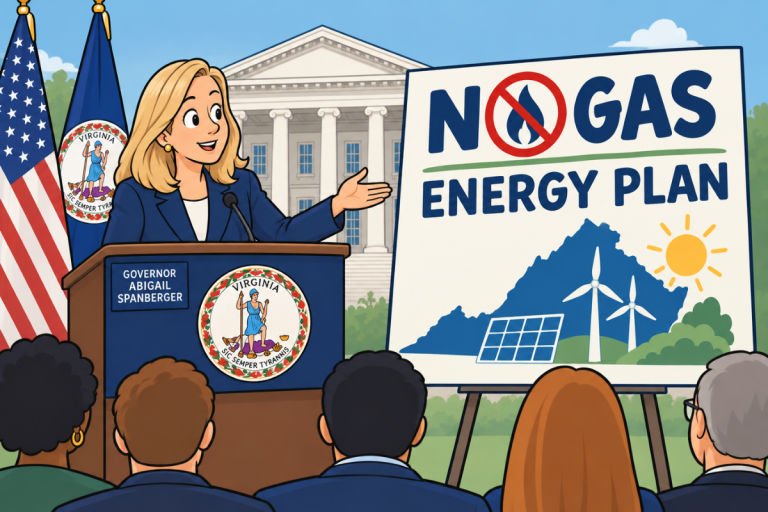
No, her key demand in the first set of conditions was a blood oath from the new management to comply with the Virginia Clean Economy Act’s goal of eliminating the use of coal and natural gas, and on a schedule faster than the law requires. Several Democratic legislators have asked for and gotten that pledge in various public forums.
Building on that in her second list of ransom demands is Spanberger’s “decarbonization incentive rate” to punish homeowners and businesses for using hydrocarbons, formation of a new Virginia-based independent company to build green and only green generation for data centers, and a huge subsidy for rooftop solar installations (subsidized by the rest of us.)
She insists on a new basic cost allocation formula to lower residential bills while raising energy costs for all commercial and industrial customers. She is implying that the methods approved by the SCC in recent decades have been unfair.
Her demand for additional cash rebates is just a pure shake-down of the companies’ shareholders. But have no sympathy for Dominion or NextEra on that front, because they started down that road with their initial offer. Give a Governor a cookie, and she will demand a glass of milk. Her demand for altering the corporate capital structure by adding more debt will cost those shareholders even more.
Three key stakeholders that the SCC which will listen to closely have all concluded there will be harm if the companies combine. The legal and financial analysis presented yesterday by the SCC’s own staff, with its conclusion that this proposal would be detrimental to ratepayers, is bound to carry the greatest weight. Unfortunately, the SCC staff joined in the demand that the company maintain a certain Virginia workforce level for a decade, which unquestionably means more money from ratepayers.
But the same conclusion of likely harm was reached by the Office of the Attorney General’s expert witnesses, and state law gives the Attorney General the role of speaking for consumers before the SCC. The third major blow to the proposal was delivered by the market monitor charged with oversight of the 13-state PJM Interconnection region that includes Virginia.
The market monitor’s testimony was filed with the Federal Energy Regulatory Commission, another agency that must approve this deal, but the PJM watchdog is also admitted to the SCC’s forum and is likely to repeat the message there. With all the generation and transmission assets the two companies own within PJM, the combined entity would have too much influence and could manipulate pricing, in its opinion.
Yet Governor Spanberger is willing for the combination to go forward if her conditions are met. Her position now is “Yes, if” and her “if” is a price that will wreck Virginia’s energy future. The SCC needs to stick to the main question posed by this application: will the new company provide reliable service at fair and reasonable rates, with no reference to how many jobs remain or the construction of some unnecessary office tower or the effort to buy support from general ratepayers.
The recommendation on that basic question that might come from Jefferson Forum remains unclear (give us some time with the documents), but Spanberger’s arrogant demands deserve full and immediate rejection. That is an easy no.
Steve Haner is the Senior Fellow for Energy and the Environment at the Jefferson Forum and may be reached at Steve@thomasjeffersoninst.org