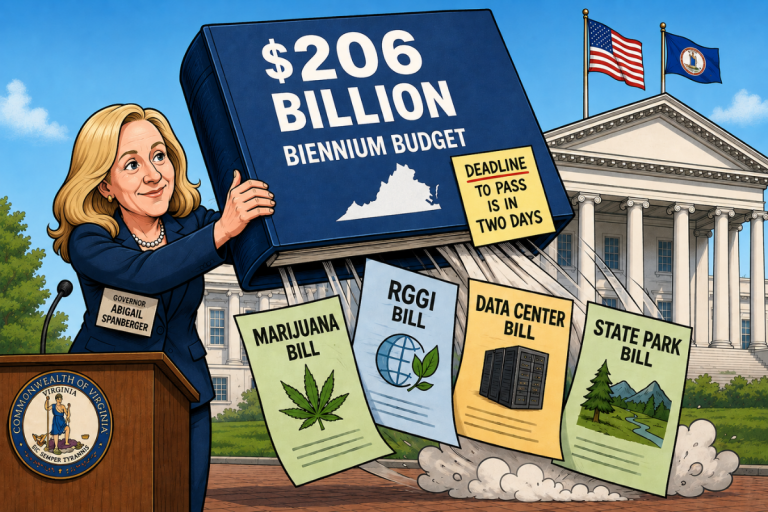
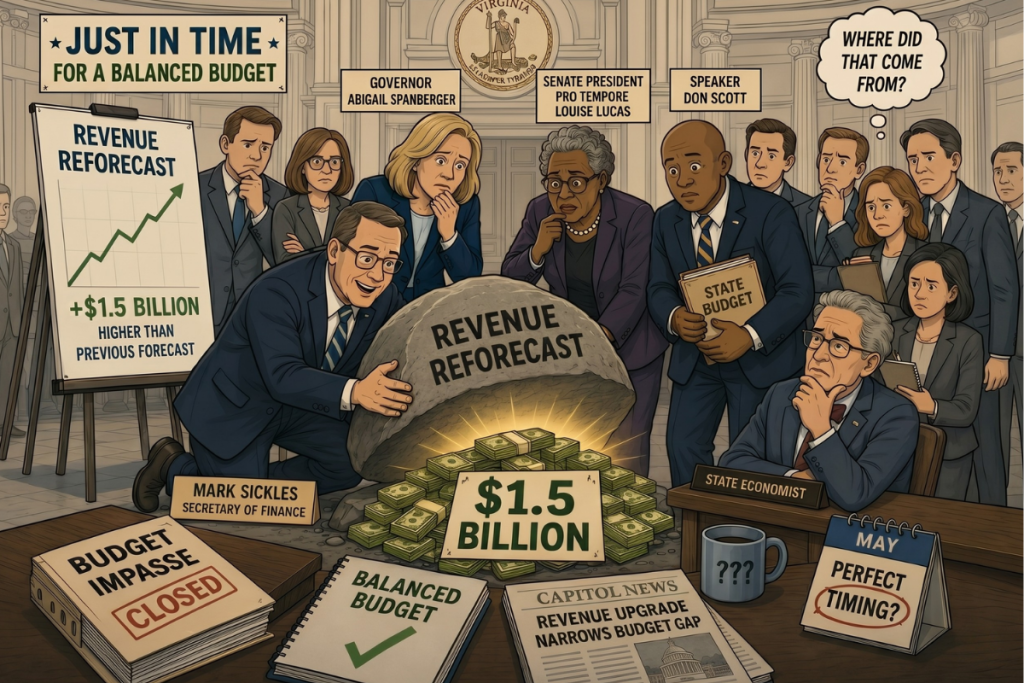
6/2/2026 — Just as Governor Spanberger and the General Assembly appeared deadlocked over how to fund competing budget priorities, Virginia’s latest revenue reforecast requested by Governor Spanberger arrived with welcome news: roughly $1.5 billion in additional projected revenue through Fiscal Year 2028.
The timing and the reforecasted increase in revenue are both remarkable.
For weeks, budget negotiations have revolved around a familiar question: where will the needed money come from? Taxing data centers? Taxing cannabis, skill games, or new casinos? Then, at precisely the moment lawmakers needed additional revenue to bridge the gap between competing tax and spending plans, Governor Spanberger’s reforecast produced almost exactly the fiscal breathing room negotiators were looking for.
To be clear, there is no evidence that Virginia’s professional forecasters manipulated the numbers. The Commonwealth has earned a well-deserved reputation for responsible revenue forecasting, and when collections exceed expectations, forecasts should be updated accordingly. In fact, the Jefferson Forum has noted how Virginia’s economy is more resilient to federal changes than it once was, and the forecasts have become overly pessimistic by not taking this fact into account.
But the coincidence on the amount of revenue added in the reforecast should not obscure a more important question: what kind of additional revenue are we talking about?
That is where everyone should proceed with caution.
The administration’s reforecast increases projected General Fund revenues by approximately $1.5 billion through Fiscal Year 2028. On the surface, that sounds like a powerful endorsement of Virginia’s economic strength.
A closer look tells a more complicated story.
The most important detail in the report is not the headline number. It is where the money comes from.
Much of the increase is driven by stronger-than-expected nonwithholding income tax collections and lower tax refunds. At the same time, withholding tax collections, the taxes generated directly from Virginians’ paychecks, were revised downward. Corporate income tax expectations were also reduced.
That distinction matters.
Withholding taxes generally reflect broad-based economic growth, rising employment, and increasing wages. Nonwithholding revenues are often more volatile. They can be influenced by capital gains, investment income, business distributions, bonuses, and other sources that may surge one year and disappear the next.
In other words, Virginia’s revenue outlook has improved, but not necessarily because Virginia’s underlying economy has become dramatically stronger.
In fact, the report itself acknowledges several reasons for caution. Federal employment remains under pressure. Professional and business services employment has weakened. Inflation remains elevated compared with historical norms. National economic uncertainty persists. These are not the conditions that typically justify expanding government commitments based on the assumption that revenue growth will continue indefinitely. Ironically, the above facts have been the talking points of most Virginia progressives as they have criticized the administration across the Potomac. Now they likely ignore these warnings in hopes of getting their budget priorities funded.
The real concern is that Richmond has a long history of treating every upward revenue revision as evidence that government can afford a larger permanent footprint — i.e., more new programs and greater spending. Governor Youngkin resisted this trend by pushing for end of year tax rebates when revenue exceeded expectations. This made sense — when you overcharge taxpayers, give it back.
That is not what is happening now.
The extra revenue found in this reforecast will not be returned to taxpayers, it is to provide much needed funding for the drunken spending spree that occurred when progressives took full control of Richmond. Historically, extra revenue has been used to strengthen reserves, reduce liabilities, pay for one-time priorities, or to provide one-time rebates. This reforecast will merely pay for what has already been spent — and be used as “proof” that the Commonwealth can spend more without raising taxes — which of course isn’t true.
Taxpayers should remember that a reforecast is still a forecast.
A projection is not cash in the bank. It is not a guarantee. Virginia’s latest revenue forecast may provide breathing room for budget negotiators. It should not become an excuse to abandon the fiscal restraint that has served the Commonwealth well. Virginia’s economy remains resilient despite repeated predictions of severe economic consequences from federal workforce reductions. It will not remain resilient in the face of massive new state spending.
Today’s news of increased revenue is due in large part to the fiscal restraint and economic development work done by the prior administration. Governor Spanberger would do well to remember that this spending spree was funded by a sound Virginia economy – she must do more to ensure the Commonwealth remains open for business. Energy must remain reliable, taxes must remain low and promises made to attract jobs to Virginia must be kept.
A revenue forecast is a projection, not a promise. And it is certainly not a blank check. In fact, it is a check that is fully contingent on a vibrant economy!
Derrick Max is Vice President of Policy at the Jefferson Forum and may be reached at dmax@jeffersonforum.org