Key Takeaways:
- The SCC’s independence is essential to protecting ratepayers — as a regulated monopoly, major decisions must be based on evidence, statutory standards and enforceable consumer protections — not political demands.
- Political influence cannot be cured with more political influence. Dominion’s longstanding power in Richmond strengthens the case for an independent Commission, not for replacing utility influence with gubernatorial intervention.
- The governor’s “non-negotiable” conditions set a dangerous precedent for future governors to use similar power to pressure the SCC on rates, power plants, transmission lines or energy mandates, gradually turning the SCC into another political arena.
Key Quote: “Nothing should be non-negotiable in an SCC proceeding except adherence to the law.”
8/7/2026 — Governor Abigail Spanberger’s announcement that she will intervene in the State Corporation Commission’s (SCC and Commission) review of the proposed Dominion Energy–NextEra merger is a reminder of why Virginia has an independent regulatory commission in the first place, and why that independence needs to be protected.
Every governor wants to promise lower electric bills. Every governor wants to protect jobs. Every governor wants to claim credit for major economic decisions. None of those political incentives are improper. They are simply the realities of elected office.
The SCC exists precisely because utility regulation should not, and cannot, be driven by those same incentives.
Virginia’s electric utilities are not ordinary private businesses. Dominion Energy Virginia operates as a state-regulated monopoly. Its customers cannot simply switch providers if management makes poor decisions or regulators allow excessive costs into rates. Because competition is absent, the Commonwealth substitutes independent regulation. That independence is not an accident of history. It is the foundation of Virginia’s utility law.
The proposed merger between Dominion Energy and NextEra deserves careful scrutiny, which is why many politicians from both sides of the aisle are calling for an extension in the review period. This merger may ultimately benefit Virginia customers, or it may not. But the decision is complex and should rest on sworn testimony, financial and economic analysis, engineering evidence and cross-examination, not campaign rhetoric or political bargaining.
Ironically, Dominion’s own political influence has always been one of the strongest arguments for preserving the SCC’s independence.
For decades Dominion has been among Virginia’s most influential political players. It has enjoyed close relationships with governors of both parties, legislative leaders and policymakers. Critics have long argued that the General Assembly has repeatedly rewritten utility statutes in ways favorable to the company, often limiting the SCC’s traditional discretion over rates and utility investments. Steve Haner has written extensively about Dominion’s influence – most recently highlighting how Virginia’s weak ethics laws fail to curtail this influence.
Whether one agrees with every criticism is beside the point. The widespread perception of Dominion’s political strength is exactly why Virginians should want major utility decisions insulated from politics.
The answer to excessive political influence is not to replace one political actor with another.
If Dominion has historically had too much influence in Richmond, the solution is not for the governor to become a second utility regulator. The solution is to allow the institution specifically designed to be independent, the State Corporation Commission, to do its job.
That means applying the law equally whether the utility is popular or unpopular, locally headquartered or based in another state, politically connected or politically isolated.
Some observers may welcome the governor’s intervention because they distrust Dominion. Others may oppose it because they favor the merger. Both reactions miss the larger institutional question, which is the precedent the Governor’s intervention may set.
Today the governor intervenes to demand lower rates and stronger labor protections. Tomorrow, she intervenes on power line routes, energy efficiency or solar metering. Yet another future governor intervenes to require faster decarbonization. A successor demands new nuclear construction. Another insists on more natural gas. Yet another pressures the Commission to reject an unpopular rate increase before an election.
At that point the SCC risks becoming another arena for political combat rather than an expert tribunal applying established legal standards. Virginia deliberately chose a different model.
The SCC’s commissioners are largely insulated from elections. They are appointed by the General Assembly rather than the governor. They serve fixed terms. They conduct formal evidentiary proceedings. Their decisions are subject to judicial review rather than political approval.
Those institutional safeguards exist because utility regulation often requires saying “no” to powerful interests. Sometimes that means saying no to utilities seeking higher rates. Sometimes it means saying yes to applications to build politically unpopular generation plants. Sometimes saying no to environmental organizations demanding accelerated mandates. Sometimes it means saying no to powerful legislators seeking politically attractive giveaways. And occasionally it may mean saying no to a sitting governor.
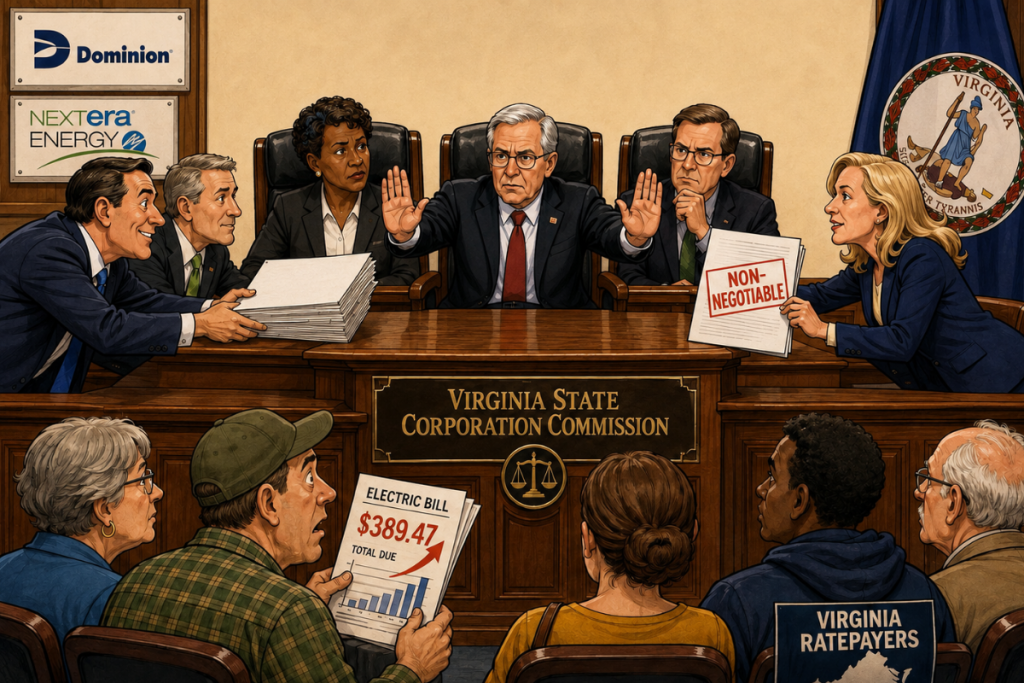
Yes, the governor has every legal right to enter the SCC case and make an evidentiary argument, although this is a role normally reserved for the Attorney General (the Governor provides no explanation as to why she is usurping AG Jones or if the AG will be intervening separately). She does not, however, have the right to announce or try to enforce a verdict in advance. Once a governor labels particular merger conditions “non-negotiable,” every independent decision by the Commission risks being judged through the governor’s political lens.
Nothing should be non-negotiable in an SCC proceeding except adherence to the law. The Commission should not begin with the governor’s priorities or “non-negotiables.” It should begin with the statutory standard. Will the merger maintain reliable service? Will rates remain just and reasonable? Are customers protected from unreasonable financial risks? Will promised merger savings actually reach ratepayers rather than shareholders? Can the commitments made today be enforced years from now after public attention has faded?
These are the questions the Commission is uniquely equipped to answer, not whether the companies have assembled a package of temporary bill credits, local headquarters, employment promises and politically fashionable investments sufficient to satisfy the governor. Political influence over a regulated monopoly cannot be cured by adding more political influence.
Dominion and NextEra are both highly sophisticated political operators, and they will naturally seek an agreement with whichever elected officials appear able to deliver approval. That is precisely the process Virginia should avoid.
Virginia has often weakened the SCC’s independence over the past two decades. Legislators have increasingly prescribed preferred generation technologies, mandatory investments, cost-recovery mechanisms and policy outcomes. Each time the Commission’s discretion is narrowed, politics moves a little farther into a field that was intentionally designed to be governed by evidence.
The Dominion–NextEra merger presents an opportunity to reverse that trend. Rather than treating the SCC as a venue for political negotiation, Virginia’s leaders should reaffirm its proper role: an independent regulator that neither utilities nor governors can command.
Dominion has always been a powerful company. Governors have always been powerful politicians. Virginia’s ratepayers need at least one institution powerful enough — and independent enough — to say no to both.
Governor Spanberger should tread carefully – and should not be making “non-negotiable” demands.
Derrick Max is Vice President of Policy at the Jefferson Forum and may be reached at dmax@jeffersonforum.org