Key Takeaways:
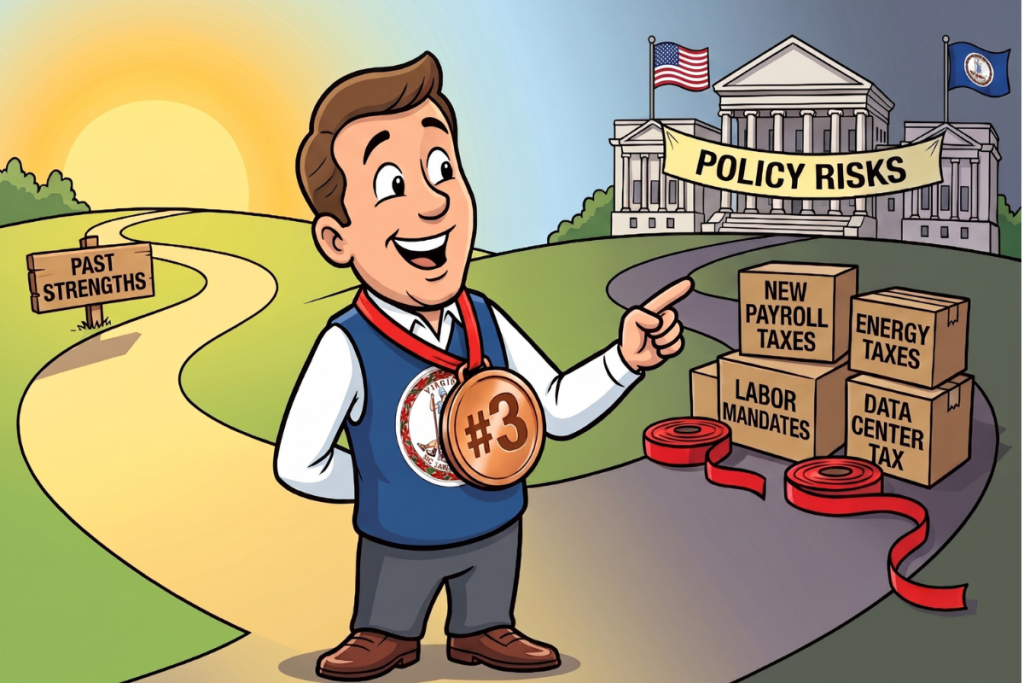
- Virginia’s rise to No. 3 in CNBC’s ranking is good news, but it reflects past strengths more than future policy risks.
- Richmond’s new labor mandates, payroll taxes, energy taxes, and data center tax could make Virginia more expensive and less competitive once fully implemented.
- To stay near the top, Virginia must protect Right-to-Work, keep taxes competitive, build reliable energy, and raise expectations in education.
Key Quote: “Virginia’s No. 3 ranking is a credit to the Commonwealth’s inherited strengths, not a blank check for Richmond to tax more, mandate more, and make it harder to do business here.”
7/9/2026 — Virginia’s climb in CNBC’s newest “Top States for Business” ranking — moving from No. 4 back to No. 3 — should be welcomed. But it should not be misunderstood.
The lesson is not that Virginia has solved its problems. It has not. Nor is the lesson that every decision coming out of Richmond is suddenly validated by a national ranking. It is not. The real lesson is more important: Virginia remains one of the strongest, most durable, most business-capable states in America — despite the federal uncertainty and despite policy choices made this year that will weaken our future competitiveness and ranking once fully implemented.
That is why conservatives should resist two temptations.
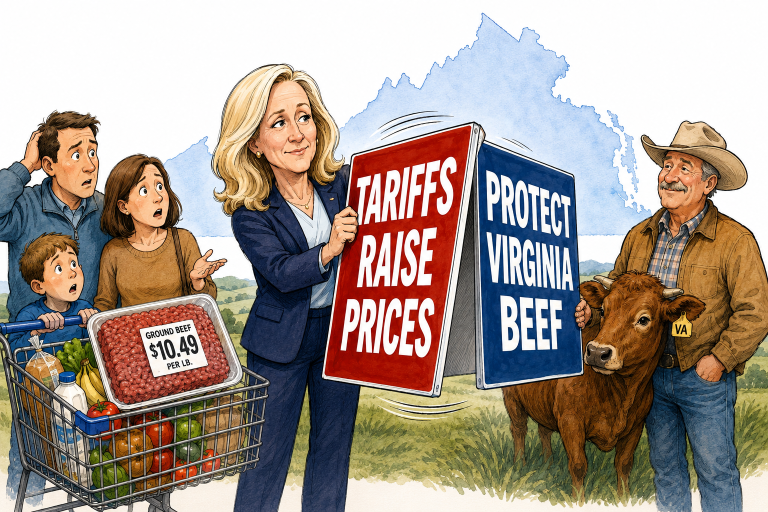
The first is despair. When Virginia fell from No. 1 to No. 4 last year, some treated the ranking as proof that the Commonwealth’s economy was collapsing. That was always too simplistic as Virginia’s economy is stronger than the headlines suggest, as we have noted. CNBC itself still recognized Virginia’s deep strengths, including top-tier performance in education and infrastructure. Virginia’s decline was driven in significant part by economic risk, federal budget exposure, and tariffs, areas where a state with a large federal workforce and federal contracting base is unusually vulnerable.
The second temptation is complacency. Moving from No. 4 to No. 3 does not mean policymakers can declare victory and move on. Rankings are snapshots. They tell us where a state stands under a particular scoring system at a particular moment. They do not tell us where a state is headed.
That matters because CNBC changes its methodology from year to year. In 2025, Virginia’s fall was tied heavily to concerns about the economy, federal job cuts, and trade exposure, even as it remained strong in education and infrastructure. Virginia Free noted that in 2026, infrastructure became an even more important part of the ranking, while economy received somewhat less weight, and access to capital became more valuable in the overall score. That surely helped Virginia, which remains strong in infrastructure, education, technology, and capital access.
That does not make the ranking meaningless. It makes it worth reading carefully.
Virginia’s strength is not accidental. It is the result of decades of advantages: a Right-to-Work tradition, proximity to the nation’s capital, the Port of Virginia, Dulles, a strong higher education network, a major defense and technology base, world-class data infrastructure, and a business culture that has historically prized stability and predictability. Companies do not invest billions here because of slogans. They invest here because Virginia can offer talent, logistics, technology, low taxes, and institutions that many states cannot match.
But here is the warning: many of the strengths CNBC rewards are backward-looking. They reflect investments already made, institutions already built, infrastructure already in place, and business confidence earned over many years. A state can rank highly today while making decisions that damage tomorrow.
That is the danger for Virginia.
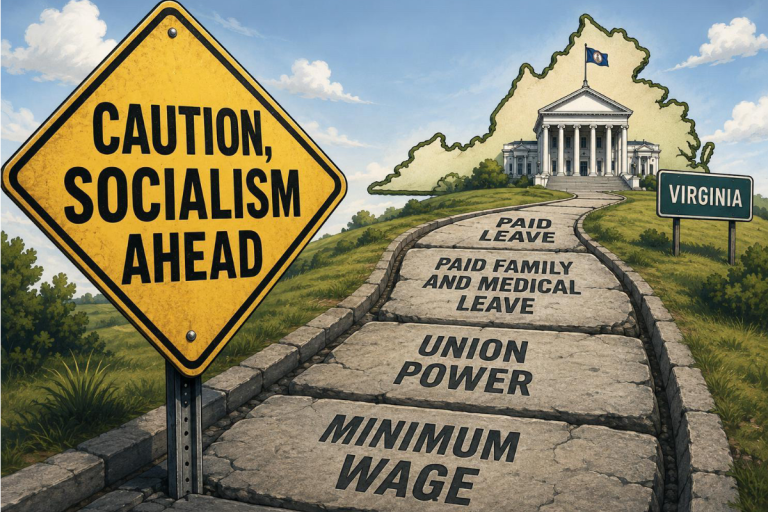
This year, Richmond did not just pass ordinary policy changes. It moved toward a much more expensive business model. Virginia enacted one of the most expansive and expensive paid family and medical leave program that will begin in 2028. Combined with a broad new paid sick leave mandate starting next year, and an already enacted hike in the minimum wage, Virginia has a new 22.5 percent labor tax that surely will impact our economy and raking going forward. Coupled with new and reinstated energy taxes, Virginia’s future looks less rosy.
Each of these policies are often defended by progressives in isolation as compassionate or worker-friendly. But employers do not experience them in isolation. A small business, manufacturer, restaurant, contractor, child-care provider, or nonprofit does not pay one mandate at a time. It pays the cumulative cost of all of them — higher wages by law, paid sick leave, paid family leave, payroll taxes, compliance costs, paperwork, scheduling disruptions, and the risk that Richmond will keep adding more.
That cumulative cost is exactly what a backward-looking ranking may miss.
The same is true for energy and data centers. The data center economy has helped make Virginia a global technology hub. It supports local tax bases, construction jobs, technology investment, and the digital infrastructure that now undergirds the modern economy. Yet the same industry that helped Virginia score well in infrastructure and technology is now being treated by some in Richmond as a political target and revenue machine.
The 2026 budget created a first-of-its-kind statewide electricity consumption tax on data centers, set at 1.1 cents per kilowatt-hour. Virginia also is returning to the Regional Greenhouse Gas Initiative, which adds costs to electricity generation and ultimately to ratepayers. That means the Commonwealth is simultaneously celebrating the industries that make us competitive while raising the price of the energy they need to operate.
That is not a long-term strategy. It is fiscal short-termism.
Data centers, advanced manufacturing, artificial intelligence, shipbuilding, logistics, life sciences, hospitals, universities, and small businesses all depend on affordable, reliable power. If Virginia wants to remain a top-three state for business, it cannot tax energy-intensive industries with one hand, restrict reliable power generation with the other, and then act surprised when investment slows, projects move, or costs rise for everyone.
The same business climate that helped attract employers is being strained by higher taxes, higher labor costs, higher energy costs, regulatory uncertainty, and proposals that make Virginia more expensive to operate in. The same education system that helps Virginia score well nationally is under pressure from low academic expectations, attempts to delay accountability, and a widening honesty gap between state tests and national performance.
If we want to remain a top-three state, we need to act like one.
That means protecting Right-to-Work. It means keeping taxes competitive. It means rejecting the idea that every successful industry is merely a future revenue source for bigger government. It means building enough reliable energy — natural gas, nuclear, coal where needed, hydro, and other dispatchable resources — to serve households, manufacturers, data centers, shipyards, labs, hospitals, and small businesses. It means moving forward on rigor in education so a Virginia diploma means real readiness, not bureaucratic self-congratulation.
It also means understanding that Virginia’s economy is changing. For years, the Commonwealth benefited from federal spending. That will remain important, especially in defense, intelligence, shipbuilding, cybersecurity, and research. But Virginia cannot rely forever on federal proximity as an economic strategy. The task now is to continue converting that historic advantage into a broader private-sector growth model: advanced manufacturing, energy abundance, artificial intelligence, life sciences, logistics, aerospace, nuclear technology, maritime industries, and entrepreneurship across every region of the state.
That is the conservative economic case for Virginia. Not managed decline. Not subsidy chasing. Not endless regulation dressed up as compassion. And not a politics of resentment toward the very employers and industries creating opportunity.
The better path is confidence with discipline.
Virginia should be proud to move up in CNBC’s ranking. And no doubt Governor Spanberger will share Virginia’s ranking with glee. It is better to be No. 3 than No. 4, and it is far better to be near the top year after year than to be an occasional flash in the pan. Over time, no state has performed better in CNBC’s rankings than Virginia. That says something real about the Commonwealth’s underlying strength.
But a ranking is not a strategy.
If policymakers use this good news as an excuse to tax more, regulate more, mandate more, and delay hard choices on energy and education, then today’s ranking will become tomorrow’s warning sign. If, instead, Virginia treats the ranking as confirmation of its assets and a reminder of its vulnerabilities, the Commonwealth can do far more than hold third place.
Virginia can lead. But only if we stop confusing inherited strength with guaranteed success.
Derrick Max is Vice President of Policy at the Jefferson Forum and may be reached at dmax@jeffersonforum.org