(Note to readers, the Virginia Board of Education needs to hear from you before Thursday’s meeting. Tell them not to delay implementing the already approved higher accountability standards. Email Secretary of Ed, Jeffery Smith – jeffery.smith@governor.virginia.gov, State Superintendent, Jenna Conway – jenna.conway@doe.virginia.gov, and Deputy Superintendent of Assessments, Performance and School Improvement, Anne Hyslop – anne.hyslop@doe.virginia.gov.)
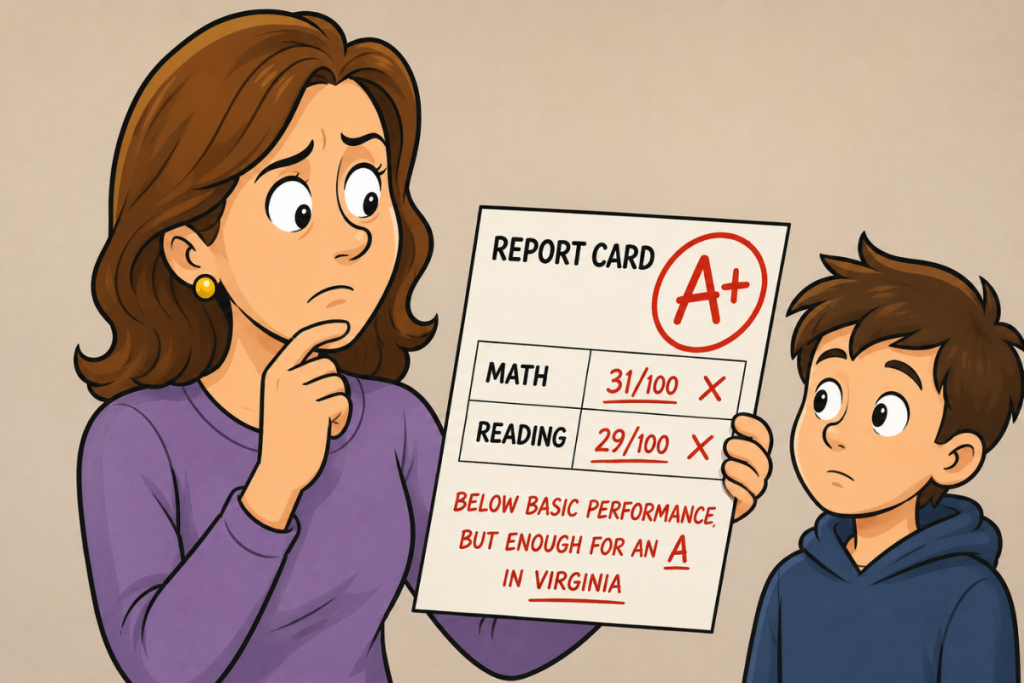
6/22/2026 — Virginia has spent too many years telling parents their children are doing better than they really are.
That is not compassion. It is not equity. It is not good education policy. It is a failure of honesty — and the students hurt most are the very children most in need of help.
The Virginia Board of Education, based on their publicly released agenda for this Thursday’s meeting, now appear poised to delay the long-overdue increase in Standards of Learning cut scores (scores needed to be considered proficient) for another three years. If that happens, Virginia will continue using some of the lowest proficiency standards in the country well into the next administration. By the time the new scores are fully reflected in public reporting, Virginia could have spent nearly a decade operating under weak benchmarks that mask the true academic condition of our schools.
That would be a serious mistake.
This should not be a partisan question. Governor Abigail Spanberger has said the right things about accountability. In her first executive order on education, she wrote that Virginia “must maintain an accountability and support system that directs additional resources to schools with the greatest need.” As a candidate, she put it plainly: “I know accountability is vital to ensuring that our kids are learning, getting the education they deserve, and getting additional help they may need if they face learning challenges along the way.”
She is right. But accountability without honest standards is not accountability at all.
For years, Virginia’s state test results have painted a much rosier picture than the National Assessment of Educational Progress, the Nation’s Report Card. That difference is often called the “honesty gap.” In 2024, Virginia reported that 73 percent of fourth graders and 72 percent of eighth graders were proficient in reading on state assessments. NAEP showed only 31 percent of Virginia fourth graders and 29 percent of eighth graders were proficient. That is a 42- to 43-point gap between what parents were told by the state and what the national benchmark revealed.
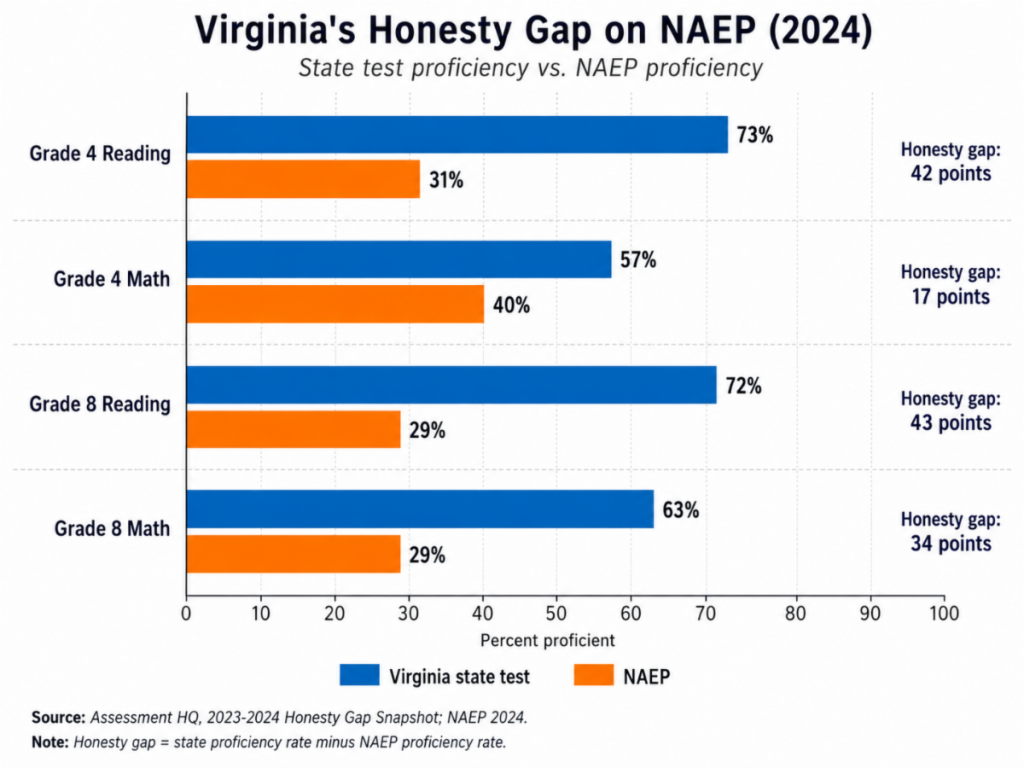
That gap is not a technicality. It means thousands of parents may believe their children are on grade level when they are not. It means schools may appear to be succeeding when many students are struggling. It means policymakers can congratulate themselves while children move from grade to grade without the reading and math skills they need.
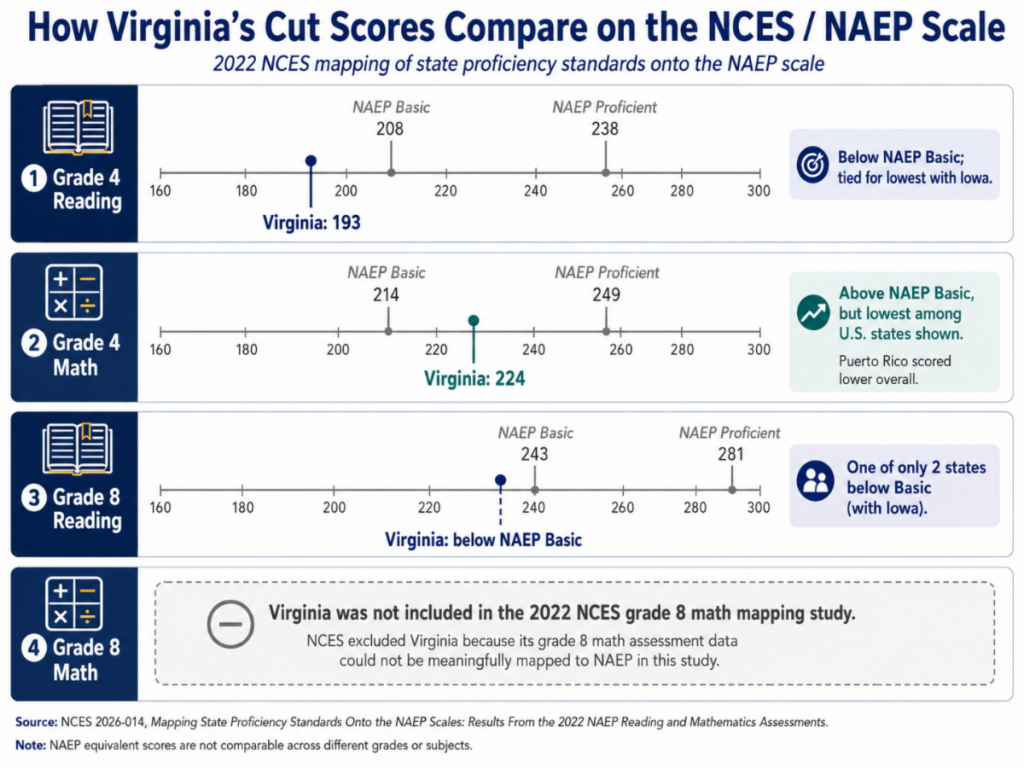
The federal data on cut scores are just as troubling. The National Center for Education Statistics has mapped state proficiency standards onto the NAEP scale so states can be compared. In grade 4 reading, Virginia was one of only two states with proficiency standards below NAEP Basic. In grade 8 reading, Virginia again was one of only two states below NAEP Basic. In grade 4 math, Virginia was at the bottom among states, excluding Puerto Rico. In other words, Virginia’s problem is not merely that students are underperforming, it is that the Commonwealth has been using low expectations to disguise their underperformance.
Education policy should start with one simple principle: tell the truth!
Parents cannot make good decisions without accurate information. Teachers cannot target instruction if the system hides which students are behind. Taxpayers cannot judge whether increased education spending is working if the state moves the goalposts. And students cannot be expected to rise to a standard adults are afraid to set.
Opponents of raising cut scores will argue that higher standards will make schools look worse. That is exactly the point. The purpose of testing is not to make adults comfortable. The purpose is to identify whether children have mastered the skills they need.
No one should pretend that raising cut scores alone will teach a child to read or solve a math problem. It will not. Higher expectations must be paired with better curriculum, stronger early literacy instruction, high-dosage tutoring, improved teacher support, school-level transparency, and real intervention for students who are behind. But will parents demand change, or seek private tutoring if they believe their children are doing well?
But lowering standards or delaying honest standards guarantees the opposite. It hides the problem. It delays help. It protects systems instead of children. It keeps parents ignorant of their child’s reality.
Virginia has already adopted more rigorous math and English standards. The Board of Education has already gone through the process of reviewing what proficiency should mean. The public has already been told that Virginia is raising expectations. To delay now would send precisely the wrong message: that when the truth becomes uncomfortable, Richmond retreats.
There is a better path. Move forward with the cut-score increases. Education funding and teacher pay have gone up significantly over the last four years and are likely to go up by another 4 percent over the next two years in the budget being voted on this week. Direct some of that money to give school divisions transition tools. Explain the change clearly to parents. But do not spend three more years pretending that weak proficiency standards are somehow a service to children.
Virginia students are capable of meeting high expectations. They are not less talented than students in Massachusetts, Florida, Maryland, Illinois, North Carolina, or other states that have aligned at least some of their state proficiency results much more closely with national benchmarks. What Virginia students need is not another delay. They need adults willing to be honest about where they are and serious about helping them improve. Our businesses rely on an educated workforce – lying about student proficiency only makes Virginia less competitive.
Governor Spanberger has said accountability is vital. The Board of Education should take her at her word.
Keep the improved accountability system. Raise the cut scores. Tell parents the truth. Then do the hard work of helping every child meet the standard.
Derrick Max is Vice President of Policy at the Jefferson Forum and may be reached at dmax@jeffersonforum.org