5/29/2026 — The ongoing fight over the future of natural gas power generation in Virginia has now moved to the Virginia Supreme Court, with environmental activists asking that court to reverse the State Corporation Commission’s (SCC) decision from six months ago approving a new gas project in Chesterfield County.
The National Association for the Advancement of Colored People (NAACP) is the lead plaintiff. The petition it filed this week raises the same claims about how the SCC had erred that were used in a failed motion for reconsideration. The main allegation is that the environmental effects will be unduly detrimental to black Chesterfield residents who live near the proposed plant location, in violation of the Virginia Environmental Justice Act.
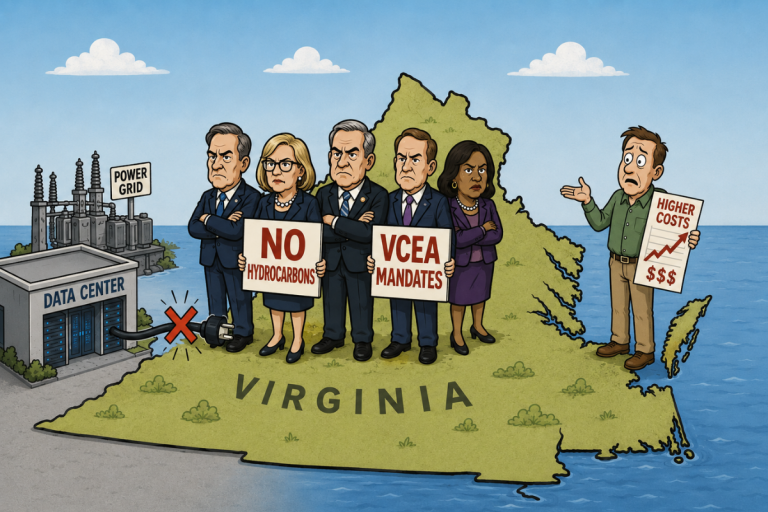
The petition also tests two key provisions of the 2020 Virginia Clean Economy Act, which was intended by its authors to prevent exactly the kind of electrical generation plant Dominion Energy Virginia wants to build. If the high court agrees with the plaintiffs and overturns the SCC, other Virginia gas plant proposals in the pipeline will also face rejection.
The opponents are challenging the SCC’s finding that because the plant is necessary to maintain system reliability for Dominion’s 2.7 million customers, that qualifies it for cost recovery through a rate adjustment clause. The VCEA from the beginning allowed the SCC to approve construction of additional gas generation if needed to maintain reliability.
And opponents are alleging that notwithstanding any reliability considerations, Dominion also was required by the VCEA to meet certain statutory energy use reduction targets as a precursor to proposing a new gas plant. Dominion has not met those targets, which were set long before the utility faced the energy demand growth wave now coming from the data center industry. Dominion likely will never meet them now.
The NAACP and other plaintiffs are represented by the Southern Environmental Law Center in Charlottesville. One of its principal attorneys has now moved on to become Democratic Governor Abigail Spanberger’s main energy advisor in a new cabinet post. Just last week at an energy conference put on by the William and Mary Law School, he reiterated the governor’s confidence that Virginia can meet its energy needs without retreating from the Virginia Clean Economy Act’s demands.
Spanberger’s response to this appeal will be telling, including if she fails to take a stance on either side. New Attorney General Jay Jones voted for the VCEA as a Democratic member of the legislature, and it would be natural for his office to intervene in a dispute over the interpretation of state law.
The Jefferson Forum supports construction of this plant as needed to balance the intermittent nature of the wind and solar power demanded by the VCEA. Even more important will be the larger plant Dominion has now announced it wants to build in Cumberland County, using the same rationale to disregard the ban on gas proponents intended in the VCEA.
The appeal comes six months after the SCC’s initial ruling in Dominion’s favor and three months after the motion to reconsider was rejected. Given their goal is to kill the plant, there is no surprise the opponents took their time getting to this point. The court might not agree to hear the appeal, and Dominion will certainly seek a quick decision.
The SCC also allowed Dominion to begin collecting money from its customers for the Chesterfield facility, which it hopes to have online by 2029 at a direct cost of about $1.4 billion. The full cost of the 944-megawatt plant will be far more than that with decades of financing costs and utility profit included in the full revenue requirement.
The charge on customer bills was set to start at 60 cents per 1,000 kilowatt hours for residential customers on January 1 this year, but that was suspended until the SCC ruled against the motion for consideration. Instead, a charge of 75 cents per 1,000 kilowatt hours was imposed as of March 1, and Dominion has already filed an application to increase it to $1.14 as of January 1, 2027.
In that application to increase what is called Rider CERC (for Chesterfield Energy Reliability Center), the utility also outlines the work already underway at the location. Contractors are removing the remnants of a retired coal-burning plant at the same power station and preparing the ground for new construction.
The cost of the plant as reviewed by the SCC is another focus of the petition to the Supreme Court, with the opponents alleging the SCC failed to examine and factor in likely fuel costs over the years of future operation before reaching the conclusion the application was reasonable and prudent.
But a more important question to watch if this appeal is granted is the impact of the Virginia Environmental Justice Act, created the same year and with the same anti-hydrocarbon intent as the Virginia Clean Economy Act. The key question to the Supreme Court will be the interpretation of the provisions within VCEA that created the potential to keep burning natural gas or coal beyond 2045 due to reliability being in jeopardy.
Those provisions were hardly hidden. But at the time, only the most prescient of observers might have foreseen the challenging demand growth situation Virginia faces six years later. And the appeal petition does not directly challenge Dominion’s assertion, or the SCC’s conclusion that a major reliability threat is looming.
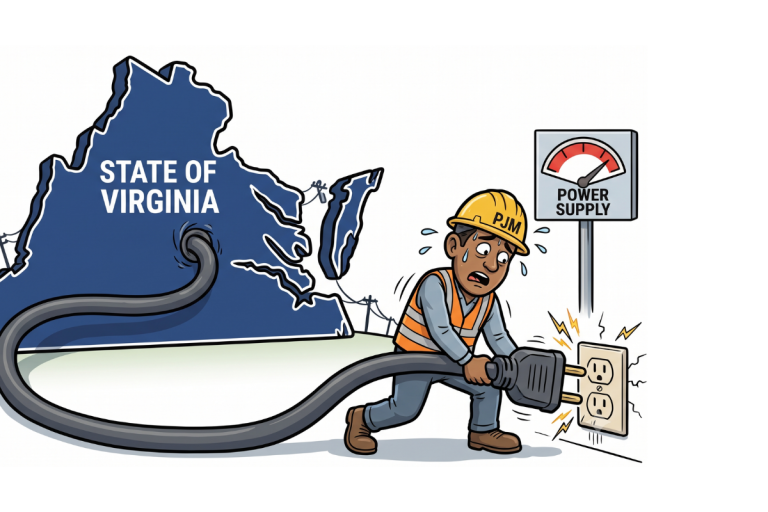
Data from the federal Energy Information Agency shows that in 2024, the last year fully compiled by EIA, Virginia used 35 million megawatt hours (MWH) of electricity imported from other states, after having imported 41 and 43 million MWH the two previous years. The excess power comes from other states within the PJM Interconnection regional energy market, some (but not all) from plants Dominion and Appalachian Power Company own in West Virginia.
On a percentage basis Virginia imported 25 percent of total power sales of 138 million MWH in 2024. Five smaller states and the District of Columbia imported a larger portion of their sales in 2024. But based on total volume of imported power, Virginia was the undisputed champion, with California second at 31 million imported MWH (13 percent of its total sales).
The Supreme Court has the last say. Should it agree with the SCC on this law’s meaning as applied to this proposed generation plant, Virginians can enjoy renewed hope that rational energy policy will prevail. Unless the General Assembly changes it again.
Steve Haner is the Senior Fellow for Energy and the Environment at the Jefferson Forum and may be reached at Steve@thomasjeffersoninst.org